Frequently Asked Questions
Product Information & iDAR Features
What is AEye's iDAR perception system?
AEye's iDAR (Intelligent Detection and Ranging) perception system is an adaptive lidar technology designed for autonomous vehicles. It enables dynamic, real-time scanning and perception, supporting all five SAE levels of vehicle autonomy by focusing on critical areas and adapting to changing environments. Learn more about iDAR.
How does iDAR support SAE's 5 Levels of Autonomy?
iDAR's unique features, such as dynamic scan patterns and software-defined architecture, enable it to meet the perception requirements for all five SAE levels of driving automation. This adaptability allows iDAR to provide the necessary data for both driver-assist and fully autonomous systems. Source.
What are the unique features of AEye's iDAR technology?
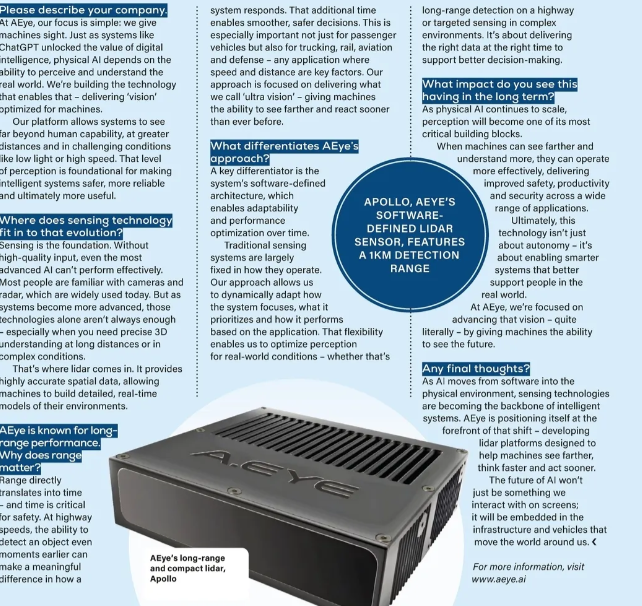
AEye's iDAR technology offers dynamic scan patterns, ultra-long-range detection (up to one kilometer with Apollo), high resolution, adaptability to challenging environments (rain, darkness, fog), software-defined customization, and over-the-air updates. These features make it suitable for a wide range of autonomous and ADAS applications. More on features.
How does AEye's iDAR differ from traditional lidar systems?
Unlike traditional lidar systems with fixed scan patterns, AEye's iDAR uses dynamic, software-defined scan patterns that can focus on critical areas in real time. This enables better detection, adaptability, and efficiency, especially in complex or changing environments. Source.
What is the Apollo lidar system and how does it relate to iDAR?
The Apollo lidar system is AEye's flagship product, featuring a small form factor and the ability to detect objects at distances up to one kilometer. It leverages iDAR technology to deliver high performance for autonomous vehicles and ADAS. Apollo Solution Page.
What is the OPTIS™ solution from AEye?
OPTIS™ is a full-stack solution from AEye that captures high-resolution 3D images, interprets them, and provides actionable insights in real time. It is designed for advanced perception in autonomous systems. OPTIS Solution Page.
What is the 4Sight Intelligent Sensing Platform?
The 4Sight Intelligent Sensing Platform is AEye's modular lidar platform that delivers precise measurement imaging for applications such as autonomous vehicles, smart infrastructure, and logistics. It is designed for safety, efficiency, and adaptability. 4Sight LiDAR technology.
What technical documentation is available for AEye's products?
AEye provides specification sheets, white papers, case studies, and technology insights. For example, the Apollo spec sheet and white papers like "Rethinking the Four Rs of LiDAR" are available on the AEye Resources Page.
Where can I find case studies and industry references about AEye's technology?
You can find case studies, industry references, and use cases on the AEye Resources Page, including documents like "Lidar Case Studies for ITS Use Cases" and articles on unique iDAR features.
What learning materials does AEye provide?
AEye offers white papers, videos, case studies, technical documentation, and industry references to help users understand its technology and applications. These are available on the resources page.
Features & Capabilities
What are dynamic scan patterns and why are they important?
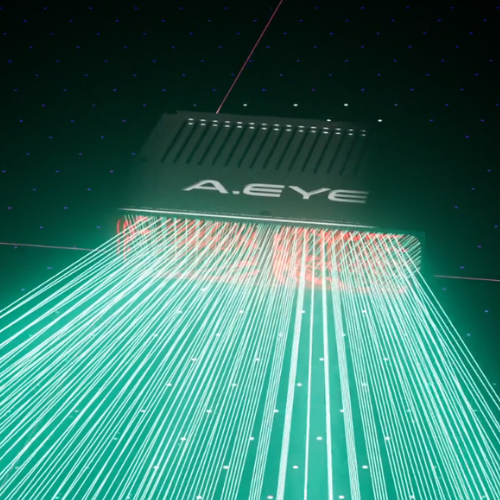
Dynamic scan patterns allow AEye's lidar to adjust its scanning focus in real time, prioritizing critical areas for enhanced safety and efficiency. This is especially valuable for autonomous driving and smart infrastructure applications. More on features.
How does AEye's lidar perform in challenging environments?
AEye's lidar systems are engineered to perform reliably in adverse conditions such as rain, darkness, and fog, ensuring consistent performance and operational reliability. Performance details.
What is software-defined lidar technology?
Software-defined lidar technology allows AEye's solutions to be customized and scaled for specific customer needs without hardware changes. Over-the-air updates keep the technology current and adaptable to evolving requirements. Learn more.
How does AEye ensure its technology remains future-proof?
AEye's lidar solutions support over-the-air updates, allowing new features and improvements to be delivered without hardware changes. This reduces the risk of obsolescence and ensures long-term value. Details.
What integration options are available for AEye's lidar systems?
AEye's Apollo 4Sight supports integration behind the windshield, on the roof, or in the grille, allowing OEMs to implement safety features with minimal impact on vehicle design. Integration details.
Does AEye integrate with NVIDIA DRIVE AGX?
Yes, AEye's Apollo sensor is fully integrated with NVIDIA's Autonomous Driving Platform, including the NVIDIA AGX DRIVE Thor™, combining long-range lidar perception with advanced AI compute capabilities. NVIDIA AGX DRIVE Thor™.
What tools and support does AEye provide for implementation?
AEye offers validation testing tools, comprehensive technical support, and user education resources, including documentation, tutorials, and hands-on training, to ensure smooth and efficient implementation. Resources.
Use Cases & Industry Applications
What industries use AEye's lidar technology?
Industries using AEye's lidar include automotive, trucking, smart infrastructure, aviation, defense, rail, and logistics. These sectors benefit from enhanced safety, operational efficiency, and adaptability. Industry case studies.
How does AEye's technology enhance safety in autonomous vehicles?
AEye's lidar enables early detection, better perception, and faster reaction times, improving safety in autonomous driving. Case studies like "A Pedestrian in Headlights" demonstrate its effectiveness in real-world scenarios. Case study.
Can AEye's lidar be customized for specific applications?
Yes, AEye's software-defined lidar solutions can be tailored to meet unique specifications, as shown in use cases like "Obstacle Avoidance" where the lidar adapts to different environments and requirements. Obstacle Avoidance use case.
How does AEye's lidar handle false positives in detection?
AEye's lidar can differentiate between real and false obstacles, reducing unnecessary braking or maneuvers. The "False Positive" use case demonstrates this capability in challenging conditions. False Positive use case.
What are some real-world success stories using AEye's lidar?
Success stories include enhanced safety in detecting pedestrians, obstacle avoidance, adaptability in adverse weather, and operational efficiency. Case studies are available for scenarios like "A Pedestrian in Headlights," "Flatbed Trailer Across Roadway," and "Cargo Protruding from Vehicle." Case studies.
Who are some of AEye's notable customers and partners?
Notable customers and partners include Continental (for volume production), Sanmina Corporation (manufacturing), and NVIDIA (integration with DRIVE platform). These partnerships reflect AEye's industry reach and trust. Customer details.
How quickly can AEye's products be implemented?
AEye's products are designed for ease of integration and quick implementation, supported by technical resources, validation tools, and expert assistance. The exact timeline depends on the use case, but the onboarding process is streamlined for efficiency. Implementation resources.
Competition & Comparison
How does AEye's lidar compare to Velodyne?
Velodyne offers traditional lidar with fixed scan patterns, while AEye provides dynamic scan patterns, software-defined customization, and over-the-air updates. This makes AEye more adaptable and future-proof for evolving applications. Comparison details.
How does AEye's lidar compare to Luminar?
Luminar focuses on long-range, hardware-centric lidar, while AEye offers dynamic scan patterns, adaptability to challenging environments, and flexible mounting options. AEye's software-defined approach provides greater customization. Comparison details.
How does AEye's lidar compare to Innoviz?
Innoviz offers solid-state lidar with limited software-defined customization. AEye's lidar is more versatile, supporting over-the-air updates, ultra-long-range detection, and high resolution for demanding applications. Comparison details.
Why should a customer choose AEye over alternatives?
Customers should consider AEye for its dynamic scan patterns, software-defined architecture, future-proof design, high performance, and flexible placement options. These features provide scalability, adaptability, and efficiency across industries. More on differentiation.
What advantages does AEye offer for different user segments?
Engineers benefit from ease of integration and validation tools; product managers value scalability and future-proofing; safety officers appreciate enhanced detection and compliance; executives focus on operational efficiency and ROI. User segment details.
Support & Implementation
What support does AEye provide during implementation?
AEye provides direct technical support, validation testing tools, and comprehensive training resources to ensure a smooth onboarding and integration process. Support resources.
How easy is it to integrate AEye's lidar with existing systems?
AEye's lidar solutions are designed for seamless integration with existing systems, minimizing disruption and enabling a quick start. Technical support and documentation are available to assist with the process. Integration support.
What feedback have customers given about AEye's ease of use?
Customers benefit from AEye's ease of integration, comprehensive technical support, user education, and validation tools, making onboarding smooth and efficient. Customer feedback.
Where can I find additional resources and documentation from AEye?
All resources, including white papers, case studies, technical documentation, and industry references, are available on the AEye Resources Page.