Collaboration pairs Apollo’s™ one-kilometer detection range with MoveAWheeL’s road-surface prediction technology to enhance ADAS and autonomous driving in adverse conditions
PLEASANTON, Calif. & DAEJEON, South Korea — May 19, 2026 — AEye, Inc. (Nasdaq: LIDR), a global leader in software-defined, high-performance lidar solutions, and MoveAWheeL, a developer of acoustic-based Physical AI road-surface sensing, today announced a Memorandum of Understanding (MOU) to explore the integration of AEye’s Apollo™ long-range lidar sensor with MoveAWheeL’s tactile intelligence technology for next-generation automotive safety and autonomous driving applications.
The collaboration will focus on enhancing Advanced Driver-Assistance Systems (ADAS) and autonomous driving capabilities by enabling vehicles not only to detect and interpret objects ahead, but also to better understand real-time road conditions that may impact braking, steering, and vehicle control. The companies intend to evaluate how Apollo’s™ long-range 3D perception can pair with MoveAWheeL’s friction-coefficient prediction technology to provide a more comprehensive understanding of the driving environment, particularly in challenging conditions such as rain, snow, and black ice.
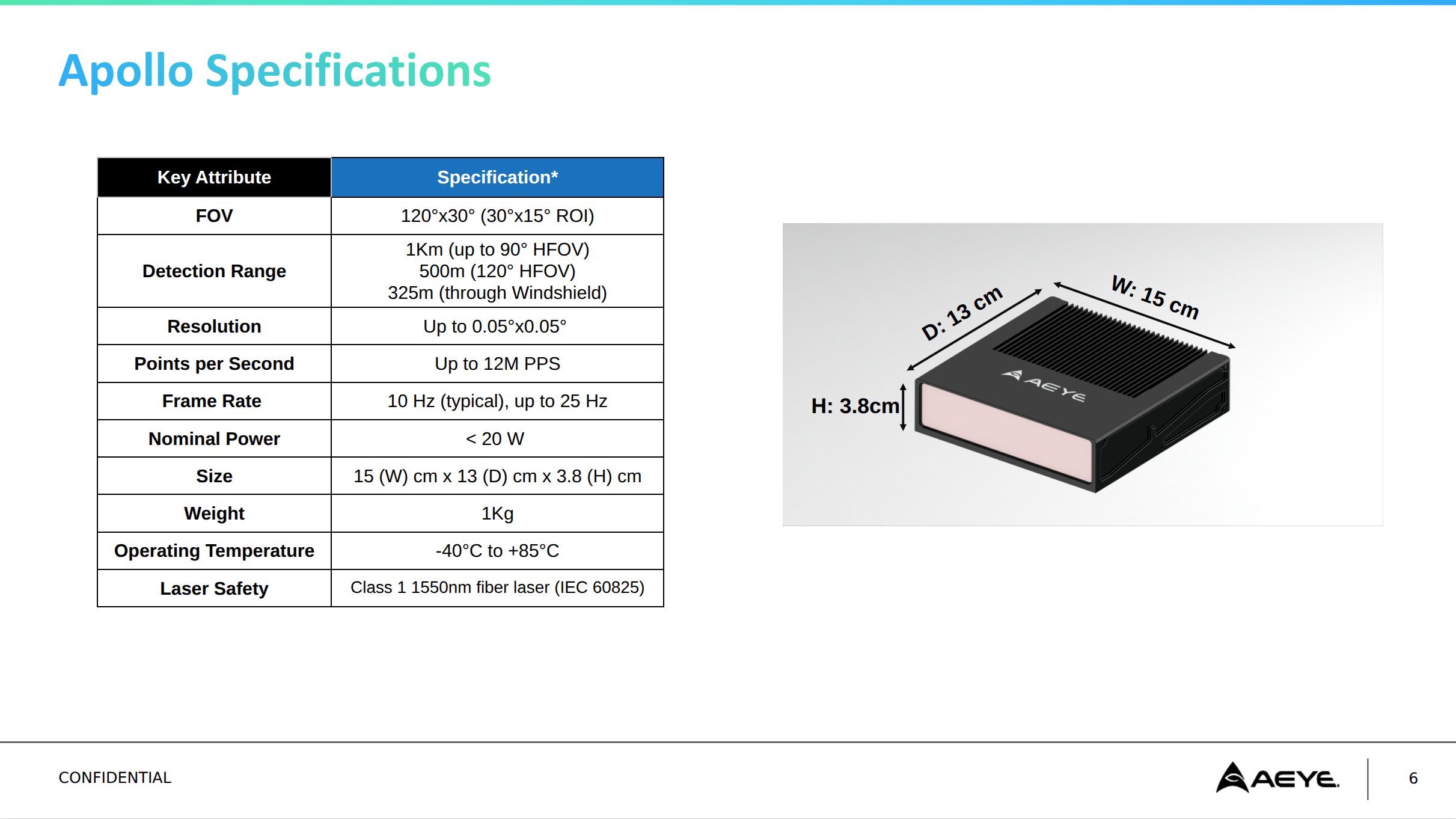
Apollo™ is a software-defined 1550-nanometer lidar sensor capable of detecting objects at distances of up to one kilometer in a compact form factor designed for behind-the-windshield automotive integration. MoveAWheeL’s road-surface prediction sensor uses active acoustic sensing to estimate friction coefficients of road surfaces, generating predictive inputs that can help inform acceleration, braking, and stability-control decisions. Together, the technologies are intended to help expand the operational capabilities of ADAS and autonomous driving systems across a broader range of real-world and adverse-weather driving conditions.
Under the MOU, the companies plan to define technical evaluation activities, identify target automotive customer engagements, and explore go-to-market opportunities in select geographies. The MOU is non-binding and is intended to guide these exploratory workstreams, with the terms of any resulting commercial relationship to be set forth in a separate definitive agreement.
“Physical AI depends on giving machines the ability to accurately perceive and understand the real world,” said Matt Fisch, Chairman and CEO of AEye. “Apollo™ was designed to deliver long-range, real-time 3D perception that helps systems see farther and react earlier in complex environments. By exploring the integration of Apollo™ with MoveAWheeL’s road-surface intelligence, we have the opportunity to create an even deeper understanding of the driving environment, particularly in the adverse conditions where advanced safety systems are needed most.”
“While Lidar provides the ‘eyes’ for a vehicle to see obstacles, MoveAWheeL provides the ‘tactile sense’ to feel the road. By integrating our Physical AI with AEye’s long-range perception, we are creating a complete safety stack that remains robust even in the most treacherous weather conditions.” Said Dr. Min-Hyun Kim, Founder and CEO of MoveAWheeL.
About AEye, Inc.
AEye offers a suite of unique software-defined lidar solutions that address a wide range of real-world needs including advanced driver-assistance, vehicle autonomy, smart infrastructure, security, defense, and logistics applications. AEye’s flagship product, Apollo™, has been widely recognized for its small form factor and its ability to detect objects at up to one kilometer. In addition to Apollo™, AEye also offers STRATOS™ with the ability to detect objects at up to one-and-a-half kilometers as well as a full-stack solution through its OPTIS™ platform. OPTIS™ provides a complete system that captures a high-resolution 3D image of the world, interprets it, and provides direction to act upon what it sees in real-time.
About MoveAWheeL, Inc.
MoveAWheeL, Inc. is a Korea-based developer of advanced AI road-infrastructure solutions, applying active acoustic sensor technology to road-surface recognition. The company’s portfolio includes road-surface detection sensors for infrastructure, the EG-Way comprehensive road-information service, and road-surface prediction sensors for vehicle acceleration- and deceleration-control applications. MoveAWheeL is headquartered in Daejeon, South Korea, with additional offices in Seoul and Gwangju. For more information, visit MoveAWheeL.
Forward-Looking Statements
Certain statements included in this press release that are not historical facts are forward-looking statements within the meaning of the federal securities laws, including the safe harbor provisions under the United States Private Securities Litigation Reform Act of 1995. Forward-looking statements are sometimes accompanied by words such as “believe,” “continue,” “project,” “expect,” “anticipate,” “estimate,” “intend,” “strategy,” “future,” “opportunity,” “predict,” “plan,” “may,” “should,” “will,” “would,” “potential,” “seem,” “seek,” “outlook,” and similar expressions that predict or indicate future events or trends, or that are not statements of historical matters. Forward-looking statements are predictions, projections, and other statements about future events that are based on current expectations and assumptions and, as a result, are subject to risks and uncertainties. Forward-looking statements in this press release include, without limitation, statements about the benefits anticipated to result from the collaboration of AEye and MoveAWheeL, the performance expectations associated with the combination of AEye’s and MoveAWheeL’s technologies, the enablement of next generation automotive safety, and improved operational capabilities of ADAS and autonomous driving systems. These statements are based on various assumptions, whether or not identified in this press release. These forward-looking statements are provided for illustrative purposes only and are not intended to serve as and must not be relied on by an investor as a guarantee, an assurance, a prediction, or a definitive statement of fact or probability. Actual events and circumstances are very difficult or impossible to predict and will differ from the assumptions. Many actual events and circumstances are beyond the control of AEye. Many factors could cause actual future events to differ from the forward-looking statements in this press release, including but not limited to: (i) the risks that the collaboration with MoveAWheeL may not yield the benefits to AEye to the extent or in the time frame anticipated, or at all; (ii) the risks that AEye’s Apollo™ may not integrate with MoveAWheeL’s road-surface sensing technology to the extent anticipated, or at all; (iii) the risks that combining AEye’s and MoveAWheeL’s technologies may not yield the benefits of an improved automotive safety solution, expanded operational capabilities of ADAS or autonomous driving systems, or a more comprehensive understanding of the driving environment across a broader range of real-world and adverse-weather driving conditions, to the extent anticipated, or at all; (iv) the risks that the MOU may not result in automotive customer engagements, definitive agreements, or otherwise materialize into a commercial relationship between AEye and MoveAWheeL; (v) the risks that Apollo™ may not deliver long-range, real-time 3D perception that helps systems see farther and react earlier in complex environments to the extent anticipated, or at all; (vi) the risks that lidar adoption may occur slower than anticipated or fail to occur at all; (vii) the risks that AEye’s products may not meet the diverse range of performance and functional requirements of target markets and customers; (viii) the risks that AEye’s products may not function as anticipated by AEye, or by target markets and customers; (ix) the risks that AEye may not be in a position to adequately or timely address either the near or long-term opportunities that may or may not exist in the evolving autonomous transportation industry; (x) the risks that laws and regulations are adopted impacting the use of lidar that AEye is unable to comply with, in whole or in part; (xi) the risks associated with changes in competitive and regulated industries in which AEye operates, variations in operating performance across competitors, and changes in laws and regulations affecting AEye’s business; (xii) the risks that AEye is unable to adequately implement its business plans, forecasts, and other expectations, and identify and realize additional opportunities; and (xiii) the risks of economic downturns and a changing regulatory landscape in the highly competitive and evolving industry in which AEye operates. These risks and uncertainties may be amplified by current or future global conflicts and current and potential trade restrictions, trade tensions, and tariffs, all of which continue to cause economic uncertainty. You should carefully consider the foregoing factors and the other risks and uncertainties described in the “Risk Factors” section of the periodic report that AEye has most recently filed with the U.S. Securities and Exchange Commission, or the SEC, and other documents filed by us or that will be filed by us from time to time with the SEC. These filings identify and address other important risks and uncertainties that could cause actual events and results to differ materially from those contained in the forward-looking statements. Forward-looking statements speak only as of the date they are made.
Investors are cautioned not to put undue reliance on forward-looking statements; AEye assumes no obligation and does not intend to update or revise these forward-looking statements, whether as a result of new information, future events, or otherwise. AEye gives no assurance that AEye will achieve any of its expectations.
Contacts
Investor Relations
AEye, Inc. Investor Relations
info@aeye.ai
925-400-4366
Keaton Olsen
lidrir@allianceadvisors.com
Media Relations
Alliance Advisors IR
Fatema Bhabrawala
fbhabrawala@allianceadvisors.com
647-620-5002
MoveAWheeL: service@mv-w.com