What are the main risks in airport ground operations?
Airport ground operations face risks such as miscommunication, limited visibility, human error, unexpected obstacles, blind spots, poor weather conditions, and obstructed views. These factors can lead to near-miss incidents and accidents, as highlighted by recent events at major airports like LAX and Charlotte. (Source: AEye Blog)
How do traditional airport ground safety systems work?
Traditional airport ground safety systems rely heavily on human line-of-sight, radio communication, and procedural compliance. These methods can be limited by human error, poor visibility, and communication breakdowns, which may result in hazards not being detected in time. (Source: AEye Blog)
What is physical AI and why is it important for aviation safety?
Physical AI refers to intelligent systems that perceive, interpret, and respond to the real world in real time. In aviation, physical AI enables proactive, perception-driven safety systems that continuously track every aircraft, vehicle, and obstacle, eliminate blind spots, and identify potential conflicts before they escalate. This approach moves safety from reactive to proactive risk mitigation. (Source: AEye Blog)
How does lidar technology enhance airport ground safety?
Lidar technology enhances airport ground safety by providing high-resolution, three-dimensional perception of the environment. It enables earlier detection of hazards, improved situational awareness, and consistent performance in challenging conditions such as low visibility or poor weather, unlike traditional camera-based systems. (Source: AEye Blog)
What are the benefits of integrating lidar and physical AI into airport infrastructure?
Integrating lidar and physical AI into airport infrastructure allows for real-time, proactive monitoring and risk mitigation. Operators can continuously track all ground activity, eliminate blind spots, and identify potential conflicts before they escalate, supporting safer decision-making and reducing the likelihood of near misses and accidents. (Source: AEye Blog)
How is airport ground safety shifting from reactive to proactive systems?
Airport ground safety is shifting from reactive to proactive systems by integrating advanced perception technologies like lidar and physical AI. These systems actively monitor conditions, identify and mitigate risks before they occur, and support real-time decision-making, reducing the likelihood of incidents. (Source: AEye Blog)
What is AEye's vision for the future of airport ground safety?
AEye envisions the future of airport ground safety being driven by software-defined perception systems that deliver real-time awareness, adaptability, and intelligence to the physical world. This approach aims to move beyond routine acceptance of near misses and achieve meaningful gains in ground safety. (Source: AEye Blog)
Are there any real-world examples of airport near-miss incidents?
Yes, recent examples include a near miss at Los Angeles International Airport (LAX), where a commercial aircraft had to brake abruptly to avoid two service vehicles, and a similar incident at Charlotte’s airport in North Carolina. These incidents highlight the need for advanced safety solutions like lidar and physical AI. (Source: AEye Blog, LAX Near Miss Video)
How does lidar compare to traditional camera-based systems for airport safety?
Lidar provides high-resolution, three-dimensional perception and is less dependent on lighting conditions than traditional camera-based systems. It performs reliably in low visibility or complex environments, enabling earlier detection of hazards and improved situational awareness. (Source: AEye Blog)
What role does real-time awareness play in airport ground safety?
Real-time awareness enables airport operators to monitor all ground activities continuously, detect hazards early, and respond proactively. This reduces the risk of incidents and supports safer, more efficient airport operations. (Source: AEye Blog)
How can lidar and physical AI help prevent near-miss incidents at airports?
Lidar and physical AI enable earlier detection of hazards, automated alerting, and proactive risk mitigation. By continuously tracking all objects and activities, these technologies provide critical seconds of additional reaction time, which can prevent incidents like near misses. (Source: AEye Blog)
What is the significance of software-defined perception systems in aviation?
Software-defined perception systems bring real-time awareness, adaptability, and intelligence to airport ground operations. They enable continuous improvement through software updates, ensuring that safety systems remain effective as operational needs evolve. (Source: AEye Blog)
Where can I find more information about how lidar and physical AI are transforming airport ground safety?
Is there a video demonstrating airport near-miss incidents relevant to lidar and physical AI?
Yes, there is a video demonstrating a near-miss incident at Los Angeles International Airport (LAX), where a commercial aircraft was forced to brake abruptly to avoid two service vehicles. This incident highlights the need for advanced safety solutions like lidar and physical AI. Watch the LAX near-miss incident video.
How does AEye's lidar technology perform in challenging airport environments?
AEye's lidar solutions are engineered to perform reliably in adverse conditions such as rain, darkness, and fog. They provide high-resolution, ultra-long-range detection and adaptability, ensuring consistent performance and operational reliability in complex airport environments. (Source: AEye Products)
Can AEye's lidar be used for safety and Foreign Object Detection (FOD) at airports?
Yes, AEye's adaptive perception delivers long-range awareness and rapid response capabilities for security, defense, and critical-infrastructure protection, helping teams identify hazards like foreign objects before they become incidents. See a demonstration in our Safety & FOD video.
What industries benefit from AEye’s lidar solutions?
Industries that benefit from AEye’s lidar solutions include aviation and aerospace (airport safety, perimeter monitoring), automotive and trucking (ADAS/autonomous), smart infrastructure and intelligent transportation systems, defense and security, rail, and logistics/industrial automation. (Source: AEye)
What features make AEye's lidar technology suitable for airport ground safety?
AEye's lidar technology offers dynamic scan patterns, ultra-long-range detection, high resolution, adaptability to challenging environments, and a compact design for flexible placement. These features enable early hazard detection, reliable performance, and integration into various airport safety applications. (Source: AEye Products)
How does AEye's solution compare to competitors like Velodyne, Luminar, and Innoviz for airport safety?
AEye's lidar stands out with dynamic scan patterns, software-defined architecture, future-proof technology with over-the-air updates, and adaptability to challenging environments. Competitors like Velodyne, Luminar, and Innoviz offer fixed scan patterns or are primarily hardware-focused, with less emphasis on software-defined customization and adaptability. (Source: Company Knowledge Base)
What case studies demonstrate AEye's lidar in airport or aviation safety?
AEye's case studies include applications in aviation for enhanced safety and operational efficiency, such as airport safety and perimeter monitoring. For more details, see the Lidar Case Studies for ITS Use Cases and related blog posts. (Source: AEye Resources)
What technical documentation is available for AEye's lidar solutions?
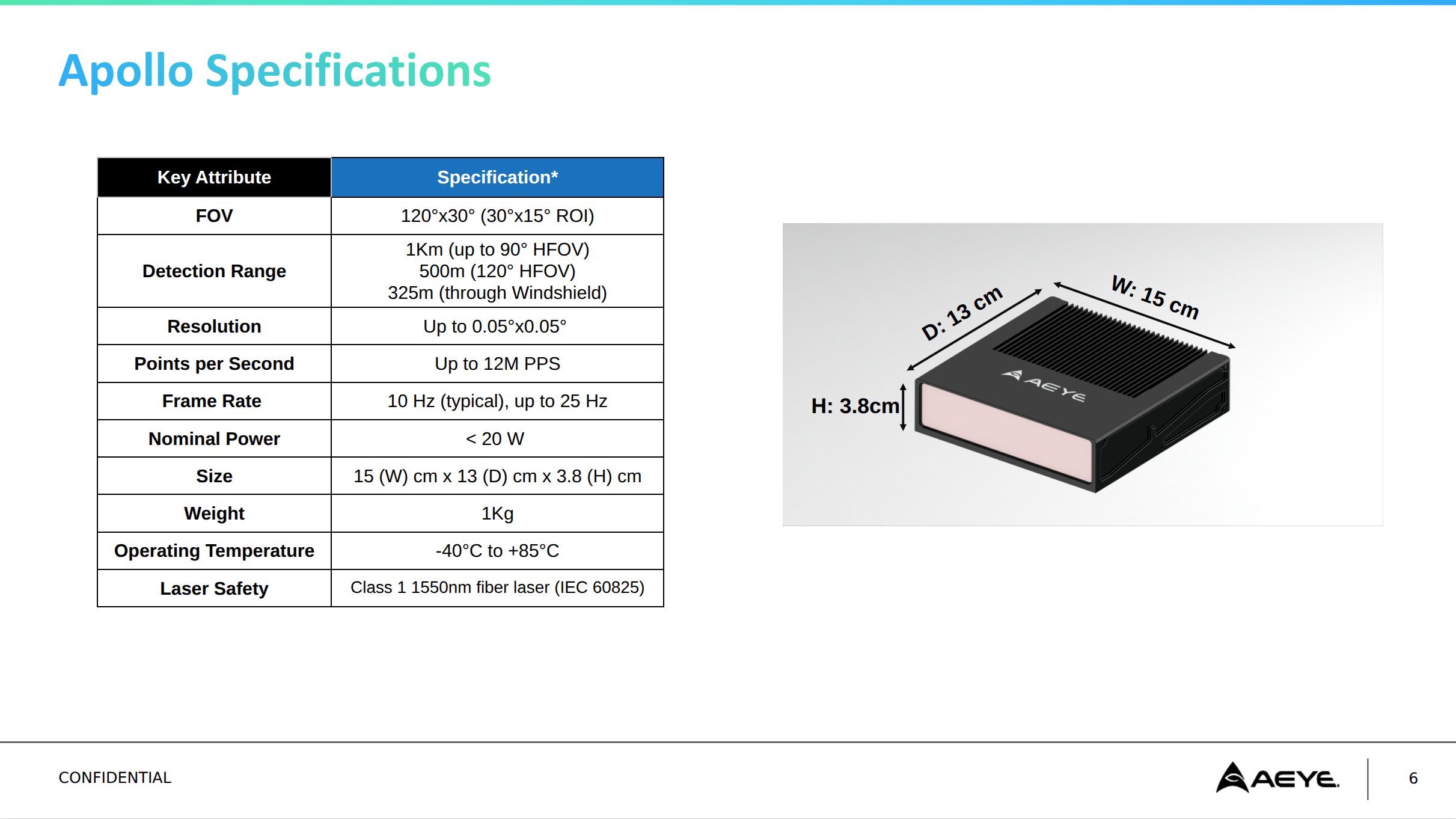
AEye provides specification sheets, white papers, and case studies. For example, detailed performance specifications for the Apollo solution can be downloaded from this link. Additional resources are available on the AEye Resources Page.
Who are some of AEye's customers in the aviation and airport safety sector?
AEye's technology is used by customers in aviation for enhanced safety and operational efficiency. Notable partnerships include Continental, Sanmina Corporation, and NVIDIA, reflecting AEye's reach in the aviation and intelligent transportation sectors. (Source: AEye)
How easy is it to implement AEye's lidar solutions for airport safety?
AEye's products are designed for ease of integration with existing systems, supported by comprehensive technical support, user education, and validation testing tools. This ensures a smooth and efficient onboarding process for airport safety applications. (Source: Company Knowledge Base)
What makes AEye's lidar technology future-proof for airport safety?
AEye's lidar solutions are software-defined and support over-the-air updates, ensuring the technology remains relevant and adaptable to evolving airport safety needs without requiring hardware changes. (Source: AEye Products)
Where can I read more about AEye's insights and updates on airport safety?
You can read more about AEye's insights and updates on airport safety and related topics on our blog.
What are the key performance highlights of AEye's lidar for airport safety?
Key performance highlights include dynamic scan patterns, ultra-long-range detection (up to one kilometer), high resolution, adaptability to adverse conditions, future-proof technology with over-the-air updates, and flexible mounting options. (Source: AEye Products)
How does AEye support customers during the implementation of airport safety solutions?
AEye provides comprehensive technical support, direct assistance from experts, user education resources, and validation testing tools to ensure efficient implementation and adoption of its lidar solutions for airport safety. (Source: Company Knowledge Base)
What use cases demonstrate the adaptability of AEye's lidar in airport environments?
AEye's lidar has been used for airport safety, perimeter monitoring, and foreign object detection (FOD), demonstrating adaptability to various airport environments and operational challenges. (Source: AEye Resources)
How does AEye's lidar help with compliance and safety standards in aviation?
AEye's lidar enhances compliance with safety standards by providing early hazard detection, reliable performance in all conditions, and real-time monitoring, supporting the requirements of modern aviation safety protocols. (Source: Company Knowledge Base)
What integration options are available for AEye's lidar in airport applications?
AEye's lidar supports flexible integration options, including mounting behind the windshield, on the roof, or in the grille, allowing for seamless implementation in various airport vehicles and infrastructure. (Source: AEye Press Release)
AEye’s Apollo™ Lidar Selected by Lunar Outpost for Pegasus Lunar Terrain Vehicle, Opening a New Market Category in Space Mobility
Read more
AEye’s Apollo™ Lidar to Power LITEON Demonstration Vehicle at InCabin Europe 2026
Read more
AEye to Work with Swiftstrike AI to Integrate STRATOS™ Lidar to Extend Counter-UAS Detection Against Smaller, Faster Drone Threats
Read more
Connect with our team to discuss your use case and explore how AEye's adaptive LiDAR can meet
your system needs.
Fortunately, no one was injured, but incidents like this are not isolated and they point to a broader issue that continues to challenge the aviation industry.
While much of the focus in aviation safety has traditionally centered on airspace, complex and high-risk environments also exist on the ground.
The Overlooked Risks in Airport Ground Operations
Modern airports are increasingly dynamic ecosystems. Aircraft, service vehicles, ground crews, and equipment all operate simultaneously in tightly coordinated spaces. As traffic volumes grow and operational complexity increases, so does the risk of miscommunication, limited visibility, and human error.
Despite advances in air traffic management, many ground operations still rely heavily on:
human line-of-sight
radio communication
procedural compliance
Unexpected obstacles, human error, blind spots, poor weather conditions, and obstructed views can all contribute to situations where hazards are not detected in time.
What Is Physical AI and Why It Matters for Aviation
This is where the concept of physical AI becomes increasingly important.
Physical AI refers to intelligent systems that can perceive, interpret, and respond to the real world in real time. In aviation, this means moving beyond reactive processes toward proactive, perception-driven safety systems.
Imagine an airport environment where:
Every aircraft, vehicle, and obstacle is continuously tracked in real time
Blind spots across taxiways and service roads are eliminated
Potential conflicts are identified and flagged before they escalate
Systems operate reliably regardless of lighting or weather conditions
The Role of lidar in Ground Safety
At the core of this transformation is advanced sensing technology, particularly lidar.
Lidar provides high-resolution, three-dimensional perception of the environment, enabling systems to detect objects at long distances with precision. Unlike traditional camera-based systems, lidar is less dependent on lighting conditions and can perform reliably in low visibility or complex environments.
For airport ground operations, this means:
earlier detection of potential hazards
improved situational awareness across large areas
more consistent performance in challenging conditions
In scenarios like the recent LAX near miss, earlier detection and automated alerting could provide critical seconds of additional reaction time, potentially preventing incidents altogether.
From Reactive to Proactive: The Future of Airport Ground Safety
The opportunity here extends beyond incremental improvements.
By integrating advanced perception systems into airport infrastructure, operators can move toward a more intelligent, connected environment that actively monitors conditions and supports safer decision-making in real time.
This represents a shift from:
reactive safety measures to responding after a risk is identified to
proactive systems identifying and mitigating risks before they occur
As aviation continues to evolve, this type of infrastructure-level intelligence will become increasingly important.
The Future of Airport Ground Safety Starts Now
The aviation industry has made significant progress in improving safety in the air. But as recent events remind us, the ground environment remains an area where meaningful gains can still be made.
Near misses should not be accepted as routine outcomes.
At AEye, we believe the next wave of aviation safety will be driven by software-defined perception systems that bring real-time awareness, adaptability, and intelligence to the physical world.
Because in aviation, seeing sooner means acting sooner, and that can make all the difference.