AEye provides advanced, adaptive lidar solutions designed to enhance safety, efficiency, and productivity across industries such as automotive, smart infrastructure, defense, aviation, and logistics. Its technology is used for applications including Advanced Driver-Assistance Systems (ADAS), vehicle autonomy, and intelligent transportation systems. Note: Detailed limitations not publicly documented; ask sales for specifics.
What are the main products offered by AEye?
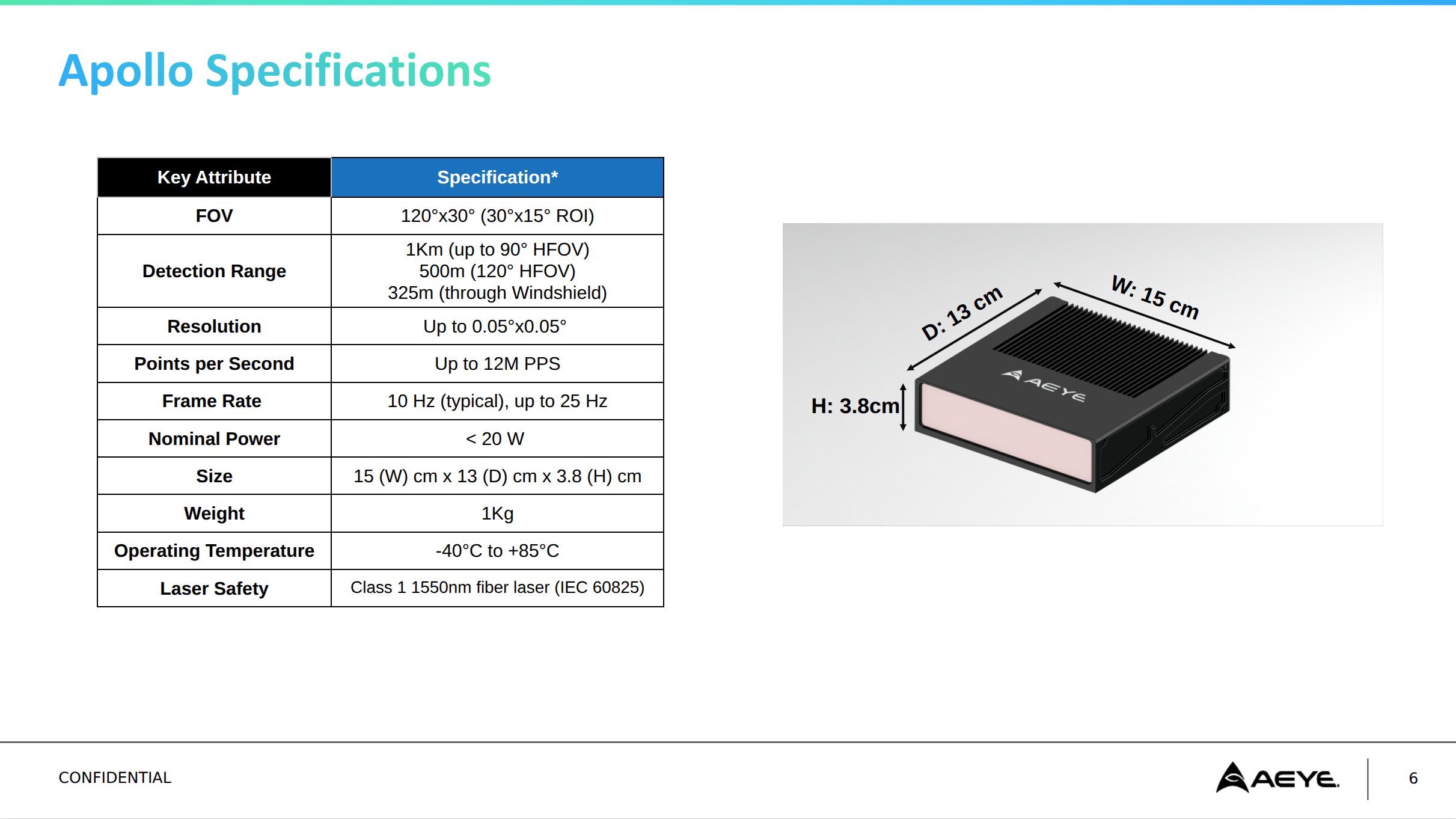
AEye's main products include Apollo (a flagship lidar system with up to one kilometer detection range), OPTIS™ (a full-stack solution for real-time 3D perception and action), and the 4Sight Intelligent Sensing Platform (for precise measurement imaging in autonomous vehicles, smart infrastructure, and logistics). Note: Each product is designed for specific use cases; not all features are available across all products.
What are the key performance features of AEye's lidar solutions?
Key performance features include dynamic scan patterns (real-time adjustment to focus on critical areas), ultra-long-range detection (up to one kilometer with Apollo), high resolution, adaptability to challenging environments (rain, darkness, fog), over-the-air updates for future-proofing, and flexible placement options (in-cabin, roof, or grille). Note: Performance may vary depending on the specific product and deployment scenario.
What technical documentation is available for AEye's products?
Technical resources include specification sheets for Apollo (download here), white papers on lidar technology, validation reports, and case studies for intelligent transportation systems. For a full list, visit AEye's Resources Page. Note: Some documents may require registration or direct inquiry.
Features & Capabilities
What makes AEye's lidar technology different from traditional lidar systems?
AEye's lidar features dynamic scan patterns (real-time adjustment to focus on critical areas), a software-defined architecture (customizable without hardware changes), over-the-air updates, and adaptability to challenging environments. These features enable use cases like early pedestrian detection and obstacle avoidance. Note: Not all features are available in every deployment; confirm with AEye for your application.
What integrations does AEye support?
AEye's Apollo sensor is fully integrated with the NVIDIA DRIVE AGX platform, including NVIDIA AGX DRIVE Thor™, combining long-range lidar with AI compute for autonomous driving. OEM integration options include behind the windshield, on the roof, or in the grille. Note: Integration capabilities may depend on the specific vehicle platform and product version.
Use Cases & Benefits
What industries use AEye's lidar technology?
Industries include automotive (ADAS and autonomy), trucking, smart infrastructure (e.g., intelligent transportation systems), aviation (airport safety and perimeter monitoring), defense, rail, and logistics. Note: Suitability for a specific industry depends on the product and deployment scenario.
What are some real-world use cases or case studies for AEye's technology?
Note: Results may vary depending on deployment and environment.
What problems does AEye's technology help solve?
AEye addresses challenges such as early detection of pedestrians and obstacles, adaptability to adverse weather and lighting, reducing false positives, and enabling over-the-air updates for evolving requirements. These solutions are documented in case studies for intelligent transportation systems and autonomous vehicles. Note: Effectiveness depends on correct integration and scenario alignment.
Implementation & Support
How easy is it to implement AEye's products and how long does it take?
AEye's products are designed for ease of integration with existing systems, supported by technical experts, validation testing tools, and comprehensive training resources. The implementation timeline varies by use case and system requirements, but these resources help ensure a smooth onboarding process. Note: Exact implementation timeframes are not publicly documented; contact AEye for specifics.
What support and training does AEye provide to customers?
Customers receive direct technical support, access to validation testing tools, and comprehensive training resources including documentation, tutorials, and hands-on sessions. These are designed to facilitate quick adoption and effective use of AEye's products. Note: Specific support levels may vary by contract or deployment.
Competition & Comparison
How does AEye compare to Velodyne?
Velodyne offers traditional lidar systems with fixed scan patterns and focuses on high-resolution imaging but lacks a software-defined architecture. AEye provides dynamic scan patterns, software-defined customization, and over-the-air updates. Choose AEye for adaptability and future-proofing; choose Velodyne if you require fixed-pattern, hardware-centric solutions. Note: Velodyne may be preferable for applications where fixed scan patterns are sufficient and software updates are not a priority.
How does AEye compare to Luminar?
Luminar focuses on long-range lidar for autonomous vehicles and is primarily hardware-focused with limited software-defined capabilities. AEye offers dynamic scan patterns, adaptability to challenging environments, and flexible placement options. Choose AEye for software-defined adaptability; choose Luminar for hardware-centric, long-range applications. Note: Luminar may be preferable for projects prioritizing hardware simplicity over software customization.
How does AEye compare to Innoviz?
Innoviz offers solid-state lidar focused on automotive applications but has limited software-defined customization. AEye provides customizable lidar solutions, over-the-air updates, and high performance for demanding applications. Choose AEye for software-defined flexibility; choose Innoviz for solid-state, hardware-centric deployments. Note: Innoviz may be preferable for applications where hardware simplicity and solid-state design are prioritized over software adaptability.
Industry Insights & Education
What were the key takeaways from the CAR MBS panel on the leap from ADAS to autonomy?
The CAR MBS panel concluded that moving from ADAS to higher autonomy is a step-change requiring new architectures, expanded sensor suites, and edge intelligence. Key points:
Edge computing is critical for handling up to 40 terabytes/hour of data in autonomous vehicles.
ADAS (L2) and full autonomy (L4/L5) require separate teams and architectures.
Level 3 autonomy is challenging due to technology, driver awareness, and liability issues; many automakers may skip L3 and move to L4/L5.
Consumer education and transparency about system capabilities and limitations are essential.
Note: The panel included representatives from AEye, Toyota, Honda Research Institute, Amazon Web Services, and AAA.
Who participated in the CAR MBS panel, 'Tapping Intelligence to Leap from ADAS to Autonomy'?
Panelists included Indu Vijayan (AEye), Nick Sitarski (Toyota), Ehsan Moradi Pari (Honda Research Institute), Vijitha Chekuri (Amazon Web Services), and Greg Brannon (AAA). Note: Panel composition may vary at future events.
How do the development approaches for ADAS (Level 2) and full autonomy (Level 4) differ?
ADAS (L2) relies on the human as the primary sensor, while L4/L5 autonomy requires the vehicle's system to replicate human perception and handle the most complex scenarios. Development teams and architectures are typically separate, with L4/L5 focusing on solving the hardest 1% of cases. Note: Collaboration between teams is common, but focus areas differ significantly.
Additional Resources
Where can I find AEye's blog for more articles and updates?
You can read more articles and updates on AEye's main blog page. Note: Blog content is updated regularly; check back for the latest insights.
AEye’s Apollo™ Lidar Selected by Lunar Outpost for Pegasus Lunar Terrain Vehicle, Opening a New Market Category in Space Mobility
Read more
AEye’s Apollo™ Lidar to Power LITEON Demonstration Vehicle at InCabin Europe 2026
Read more
AEye to Work with Swiftstrike AI to Integrate STRATOS™ Lidar to Extend Counter-UAS Detection Against Smaller, Faster Drone Threats
Read more
Connect with our team to discuss your use case and explore how AEye's adaptive LiDAR can meet
your system needs.
Consumers are acclimating to ADAS safety features, as applications that used to be premium add-ons (think: Adaptive Cruise Control and Lane Centering/Lane Keeping) are becoming standard issue on mainstream vehicle models. But the transition from ADAS to autonomy is a complex one, requiring cars to acquire human-like intelligence to safely navigate roadways with little to no human intervention.
Last week’s CAR MBS panel, Tapping Intelligence to Leap from ADAS to Autonomy, tackled the competencies and roadblocks required to move from L2 to L4, with panelists from AEye, Toyota, Honda Research Institute, Amazon Web Services and AAA agreeing that the transition is more than a process evolution: safely deploying higher level autonomy is a step-change that requires a fresh look at architectures and education.
An Architectural Shift
While current architectures, which largely leverage camera and radar sensors, suffice for basic ADAS features, their shortcomings become clear as automakers add more nuanced and advanced safety features. AAA’s Director Automotive Engineering and Industry Relations Greg Brannon offered a case in point with Lane Centering, noting the safety issues that have arisen due to what he believes is heavy reliance on cameras and unreliable lane markings.
According to AEye’s Director of Product Management, Automotive, Indu Vijayan, as auto makers look to implement higher levels of autonomy, they must both expand their sensor suite, and integrate sensors with built-in intelligence to ensure redundancy and safety. Vijayan described AEye’s lidar, a situationally aware sensor that captures better information using less data, as providing the kind of edge intelligence needed to get to perception faster (to be within safe reaction times, where use cases with time-to-collision are lower.)
“The same sensor capability should now be able to get more information from the scene and be able to send that information to the higher perception and path plan system. Having that kind of feedback loop, with understanding what’s happening in the situation, enables the sensor to give the most relevant data, without overloading the system with too much data, so that decisions can be made much faster, since accidents happen in seconds,” says Vijayan.
Honda Research Institute (HRI)’s Lead Scientist, Ehsan Moradi Pari, spoke on the importance of edge intelligence, and training AI to handle a diversity of situations in order to minimize accidents: “If you look at the roadways and the city urban areas, you see scooters, you see e-bikes, and other mobility solutions that all have limited computation capabilities. It’s important to understand how edge computing can help minimize fatalities and crashes.”
In addition, edge computing helps alleviate what AWS’ Global Head of Business Development and GTM for ADAS, Vijitha Chekuri, calls the “big data and compute problem”: Autonomous vehicles will generate as much as 40 terabytes of data an hour from cameras, radar, and other sensors—equivalent to an iPhone’s use over 3,000 years—and suck in massive amounts more to navigate roads, according to Morgan Stanley.
Artificial intelligence, data analytics, and edge computing are more important than ever to tame this data torrent. But what does this mean for development?
Two Teams – Two Focuses
Once seen as a building block to L4 and L5 autonomy, the panelists largely see ADAS as a separate but complementary endeavor, with disparate use cases, requiring different teams and architectures.
According to Toyota’s Vice President Integrated Vehicle Systems Nick Sitarski, “Level 2 and Level 4 .. use a lot of the same sensors, but the biggest difference is that on a Level 2 system, the most capable sensor in a system is the human… In a Level 4 system, the initial complexity is really trying to recreate what the human is doing, and that’s just not easy.”
At L4 and L5 autonomy, the vehicle takes over human responsibility while the Automated Driving System (ADS) is activated. At this stage, panelists agreed, the perception system has to solve the last 1% of corner cases – the toughest ones. This will require both a leap in architecture, and collaboration between ADAS and AV development teams.
AWS’ Chekuri explains, “The last 5 or last 1% is the hardest to get to. So, when we look at the teams or customers working there, it’s very focused at L4 and L5, and ADAS is also an extremely focused effort, and it’s here and now…They are going to collaborate on the technology and they need to do some best practices and patterns that fit for ADAS, but (L4 teams) are focusing their efforts on solving that last 1%.”
The Software-Focused Future
As cars evolve, at all levels, to become software-driven like our phones, the development process becomes even more critical. Consumers are already asking for Over the Air (OTA) upgrades, but, when updates and services happen continuously via software, how does that change the back end? AWS and AEye talked about the need to separate hardware and software in order to move fast, as well as the need to validate ahead.
According to AWS’ Chekuri, “Not waiting until the hardware is ready to validate, doing the software in the loop validation ahead, and making those models available in the software to be as accurate as possible compared to your hardware…This area is going to get a lot of momentum going forward because it will take the costs out and speed up development.”
Panelists agreed, while the importance of robust hardware remains, the focus on software will be a game-changer, with the need to validate earlier before services are deployed in the market.
What about L3?
In short, it’s complicated. While engineers like to do things in sequence, Level 3 requires a mix of technology proficiency, driver awareness and OEM culpability that most OEMs aren’t comfortable with. According to AAA’s Brannon, “Most people would be writing on the road, reading a book or checking their email, and then re-engage in an emergency situation..It’s very challenging and there’s a lot of liability that comes with it. I don’t think anybody wants to be first.”
And that’s where the development divide comes in. Many feel that automakers will push the envelope on Level 2 solutions, achieving L2+++ capabilities, and largely skip over Level 3 – instead jumping to L4 and L5 autonomous solutions, where the driver is not expected to engage.
Education. Education. Education.
With all this talk, and confusion, over levels of autonomy, panelists concurred on the importance of communication and transparency with consumers, saying it’s going to take “a village” to continue to educate people about these technologies.
According to Sitarski, “Right now in the mass market there are no autonomous vehicles… There’s lot of vehicles with assist systems and I think it’s critical that we’re transparent and honest with customers about what those systems are and what they’re capable of and what they’re not capable of.”
Moradi Pari echoed “That’s why we see ADAS as a bridge to learn, improve and evolve toward automated driving.”