Frequently Asked Questions
Product Information
What is AEye's 4Sight™ lidar for automotive?
AEye's 4Sight™ lidar for automotive is a software-defined, adaptive lidar solution designed to deliver ultra-long-range detection, high-speed obstacle perception, and classification for automotive and commercial vehicle automation. It supports the transition to electric vehicles (EVs) and future OEM subscription models, and is engineered for integration by Tier 1 partners. Source
What are the main features of AEye's 4Sight™ lidar?
Key features include ultra-long-range detection, advanced vision capabilities (identifying small obstacles like pedestrians at over 300m), reliability and safety via a bistatic design, integrated intelligence for reduced false positives, adaptability with triggered performance modes, software configurability for future-proofing, and a patented bistatic architecture that separates transmit and receive channels for optimized performance. Source
How does AEye's 4Sight™ lidar support automotive industry needs?
4Sight™ lidar meets automotive industry needs by providing the longest detection range for high-speed highway obstacle detection, customizable performance modes for various driving conditions, and optimal size, weight, power, and cost profiles. It is designed for seamless operation from highway speeds to complex, low-speed environments like traffic jams or parking. Source
What is the 4Sight Flex product?
4Sight Flex is AEye’s next-generation, compact, low-power lidar design optimized for high-performance behind-the-windshield automotive applications. It is engineered for industrialization and integration by Tier 1 partners. Source
How is AEye's lidar technology integrated into vehicles?
AEye’s design allows for adaptive placement options, leveraging software configurability for mounting in the grille, roof line, or behind the windshield, supporting OEM design flexibility and integration by Tier 1 partners. Source
What is the bistatic architecture in AEye's lidar?
AEye’s patented bistatic architecture separates the transmit and receive channels, allowing for independent optimization and enabling intelligence to be introduced at the point of acquisition, which improves reliability and data quality. Source
How does AEye's lidar improve reliability and safety?
The bistatic design enables the smallest low-mass mirror (~1mm) with the fastest resonance (over 10kHz), resulting in proven solid-state reliability and enhanced safety for automotive applications. Source
What is meant by 'software-defined' lidar?
Software-defined lidar refers to AEye’s ability to customize and upgrade lidar performance through software, allowing customer-centric customization, upgradability, and future-proofing of autonomous development without hardware changes. Source
How does AEye's lidar enable advanced vision capabilities?
AEye’s adaptive lidar can accurately detect small obstacles, such as pedestrians, at distances over 300 meters, surpassing the limitations of cameras and radar for automotive safety. Source
What are triggered performance modes in AEye's lidar?
Triggered performance modes allow AEye’s lidar to enable features like highway autopilot by detecting vehicle cut-ins in traffic using a 128° wide horizontal field of view and 0.05° high resolution at fast speeds. Source
Features & Capabilities
How does AEye's lidar adapt to different driving environments?
AEye’s lidar enables customized performance modes, allowing a single sensor to operate in multiple environments and driving conditions, from high-speed highways to complex, low-speed situations like parking or traffic jams. Source
What is the advantage of integrated intelligence in AEye's lidar?
Integrated intelligence in AEye’s lidar increases the probability of detection and reduces false positive rates, resulting in higher quality data collection for automotive applications. Source
How does AEye's lidar support future-proofing for OEMs?
AEye’s adaptive, software-configurable lidar allows for customer-centric customization and upgradability over time, enabling OEMs to future-proof their autonomous vehicle development and adapt to evolving requirements. Source
What manufacturing partnerships does AEye have for automotive lidar?
AEye engages world-class Tier 1 partners for industrialization and manufacturing of its automotive lidar products, ensuring quality and scalability for OEM customers. Source
How does AEye's lidar contribute to cost reduction?
AEye’s adaptive, software-configurable lidar enables cost reduction by allowing for customer-centric customization and upgradability, reducing the need for hardware changes and supporting long-term value for OEMs. Source
What is the field of view and resolution of AEye's lidar?
AEye’s lidar offers a 128° wide horizontal field of view and 0.05° high resolution, enabling precise detection and classification of objects at high speeds. Source
How does AEye's lidar support the transition to electric vehicles (EVs)?
4Sight™ lidar is designed to fully meet the needs of automotive and commercial vehicle automation, including the transition to EVs, by offering a compact, low-power, and software-defined solution that supports future subscription models for OEMs. Source
Use Cases & Benefits
What automotive applications is AEye's lidar designed for?
AEye’s lidar is designed for advanced driver-assistance systems (ADAS), autonomous driving, high-speed highway obstacle detection, and complex low-speed environments such as traffic jams and parking. Source
How does AEye's lidar improve safety in automotive applications?
AEye’s lidar improves safety by providing ultra-long-range detection, high-resolution imaging, and the ability to identify small obstacles like pedestrians at over 300 meters, reducing the risk of accidents in both high-speed and complex environments. Source
How does AEye's lidar help with vehicle autonomy?
AEye’s lidar supports vehicle autonomy by delivering precise perception and classification capabilities, enabling advanced driver-assistance systems and paving the way for fully autonomous vehicles. Source
What are some real-world use cases for AEye's automotive lidar?
Real-world use cases include highway autopilot, pedestrian detection, obstacle avoidance, and operation in challenging environments such as rain, darkness, and fog. Case studies like 'A Pedestrian in Headlights' and 'Flatbed Trailer Across Roadway' demonstrate these capabilities. Case Study
How does AEye's lidar perform in adverse weather conditions?
AEye’s lidar systems are engineered to perform reliably in challenging environments, including rain, darkness, and fog, ensuring consistent performance and operational reliability for automotive applications. Source
Technical Requirements & Documentation
Where can I find technical documentation for AEye's automotive lidar?
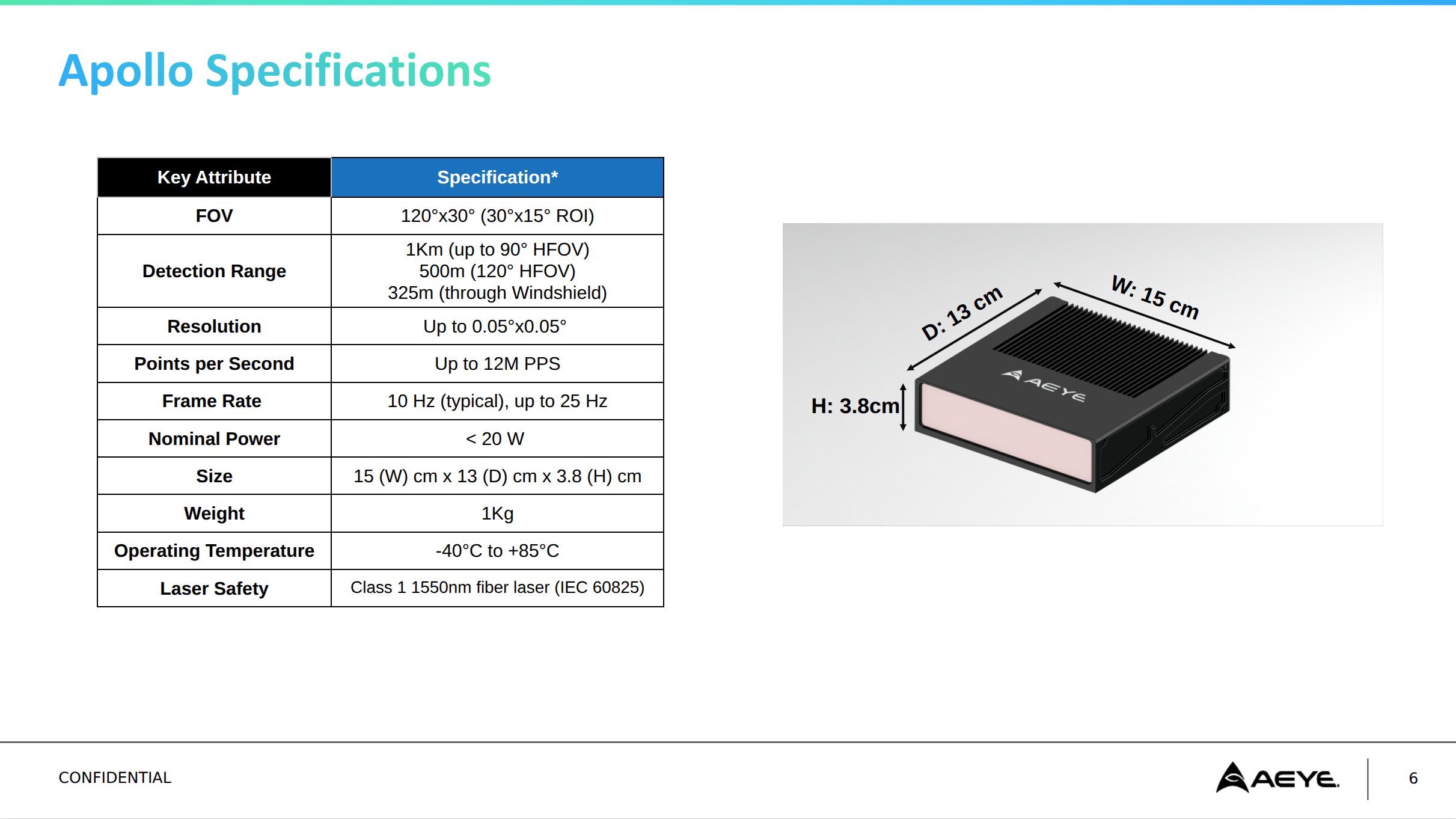
Technical documentation, including specification sheets and white papers, is available on AEye’s Resources page. For detailed performance specifications, download the Apollo spec sheet at this link. Resources
What validation or testing tools are available for AEye's lidar?
AEye provides validation testing tools to simplify the testing and validation process, ensuring the product meets specific application requirements for automotive customers. Source
What training and support does AEye offer for automotive lidar customers?
AEye offers comprehensive training resources, including documentation, tutorials, and hands-on training sessions, as well as direct technical support to assist customers during implementation and integration. Source
Competition & Comparison
How does AEye's lidar compare to Velodyne's automotive lidar?
Velodyne offers traditional lidar systems with fixed scan patterns and focuses on high-resolution imaging but lacks a software-defined architecture. In contrast, AEye’s lidar features dynamic scan patterns, software-defined customization, and over-the-air updates, providing greater adaptability and future-proofing for automotive applications. Source
How does AEye's lidar differ from Luminar's automotive lidar?
Luminar focuses on long-range lidar for autonomous vehicles with a primarily hardware-based approach. AEye’s lidar offers dynamic scan patterns, adaptability to challenging environments, and flexible placement options, making it suitable for a wider range of automotive use cases. Source
What advantages does AEye's lidar offer over Innoviz for automotive applications?
Innoviz provides solid-state lidar with limited software-defined customization. AEye’s lidar stands out with its software-defined architecture, over-the-air updates, and ultra-long-range, high-resolution detection, making it more versatile and future-proof for automotive OEMs. Source
Why should automotive OEMs choose AEye's lidar over competitors?
Automotive OEMs should consider AEye’s lidar for its dynamic scan patterns, software-defined customization, future-proof design with over-the-air updates, high performance, and flexible placement options, all of which support scalability, adaptability, and efficiency. Source
Support & Implementation
How easy is it to integrate AEye's lidar into automotive systems?
AEye’s lidar solutions are designed for ease of integration with existing automotive systems, supported by comprehensive technical resources, validation tools, and direct technical support to ensure a smooth and efficient onboarding process. Source
What support does AEye provide during implementation?
AEye provides direct assistance from technical experts, extensive documentation, tutorials, and hands-on training to help customers resolve challenges efficiently during the implementation phase. Source
How long does it take to implement AEye's lidar in automotive applications?
While the exact timeline varies by use case and system requirements, AEye’s focus on ease of integration, validation tools, and comprehensive support ensures a quick and efficient implementation process for automotive customers. Source
Industry & Customer Proof
Who are some of AEye's automotive customers and partners?
Notable automotive partners include Continental, which selected AEye’s high-performance sensor for volume production starting in 2024, and NVIDIA, which collaborates with AEye to bring adaptive, intelligent sensing to the NVIDIA DRIVE® autonomous vehicle platform. Source
What industries are represented in AEye's automotive lidar case studies?
Industries include automotive, trucking, smart infrastructure, aviation, defense, rail, and logistics, demonstrating the versatility of AEye’s lidar technology in real-world automotive and transportation applications. Source
Where can I find more information about AEye's automotive lidar solutions?
For more information, visit the AEye 4Sight™ Lidar for Automotive page, the Apollo and OPTIS™ solution pages, and the Resources section for technical documentation, case studies, and videos. Automotive Lidar | Resources