Frequently Asked Questions
About AEye & Company Background
What does AEye do?
AEye specializes in advanced, adaptive lidar solutions designed to enhance safety, efficiency, and productivity across industries such as automotive, smart infrastructure, defense, logistics, and more. Its technology is used in applications like Advanced Driver-Assistance Systems (ADAS), vehicle autonomy, and smart infrastructure projects. [Source]
Who is Ben Hua and what is his role at AEye?
Ben Hua is the VP of Operations at AEye, responsible for global supply chain and manufacturing management. He oversees partnerships with contract manufacturing companies, ensuring excellence in manufacturing, product quality, and cost reduction in the supply chain. Ben brings over 30 years of experience in optics and telecom, with a Ph.D. in Optics and extensive industry leadership roles. [Source]
What is the significance of AEye's decision to use 1550 nm lasers?
AEye chose 1550 nm fiber lasers for its lidar because this wavelength offers superior eye safety compared to 905 nm, allows for higher power for long-distance detection, and provides better beam quality (Gaussian-shaped optical beam with M2 close to 1). Additionally, 1550 nm fiber lasers minimize electromagnetic interference, making them ideal for automotive and industrial applications. [Source]
How does AEye approach cost reduction in its lidar products?
AEye employs multiple strategies for cost reduction, including optimizing subcomponent selection, using multiple sources for components, migrating to larger wafer sizes for MEMS mirrors, and increasing automation in assembly. Collaborating with Tier 1 partners also enables further cost savings through supply chain scale and procurement leverage. [Source]
What impact does AEye's cost-down strategy have for OEMs?
AEye's focus on cost reduction results in a cost-effective lidar solution, making it easier for Tier 1 suppliers to quote AEye's technology for RFQs. A vetted supply chain reduces technical and manufacturing risk, and cost-effective adoption for new Tier 1s is facilitated, especially as production volumes increase. [Source]
What is Ben Hua's background in optics and telecom?
Ben Hua has a Ph.D. in Optics and post-doctoral experience in Fiber Optical Communications Systems and Optical Fiber Amplifiers & Lasers. He has held management roles in R&D, product marketing, and special task force programs at companies like E-TEK Dynamics, JDSU/Lumentum, and O-Net Technologies. [Source]
How does AEye's supply chain strategy contribute to cost reduction?
AEye's supply chain strategy includes using multiple sources for components, migrating to larger wafer sizes for MEMS mirrors, and leveraging automation in assembly. Working with Tier 1 partners allows AEye to benefit from their procurement scale, further reducing costs. [Source]
What are some personal insights from Ben Hua about transportation technology?
Ben Hua enjoys using radar-based Adaptive Cruise Control and camera-based Lane Keeping Assist in his car. He looks forward to driving a vehicle equipped with hands-free ADAS functions using AEye’s lidar in the near future. [Source]
How does AEye ensure product quality and performance?
AEye ensures product quality and performance through excellence in manufacturing, robust supply chain management, and continuous cost reduction efforts. The company partners with contract manufacturers and Tier 1 suppliers to maintain high standards and reliability. [Source]
What is the benefit of using fiber lasers in AEye's lidar systems?
Fiber lasers at 1550 nm provide superior eye safety, better beam quality, and minimal electromagnetic interference. This enables AEye's lidar to achieve high performance in long-range detection and safe operation in automotive and industrial environments. [Source]
How does AEye's modular lidar architecture support cost reduction?
AEye's modular lidar architecture allows for more automation in assembly and easier migration to cost-effective manufacturing processes, such as larger wafer sizes for MEMS mirrors. This modularity streamlines production and reduces costs. [Source]
How does AEye's supply chain benefit Tier 1 partners?
AEye's supply chain, vetted by Tier 1 partners, reduces technical and manufacturing risk for new adopters. It also enables cost-effective scaling as production volumes increase, making AEye's lidar more attractive for large-scale automotive deployments. [Source]
What is the main advantage of using 1550 nm over 905 nm lasers in lidar?
The main advantage is improved eye safety, which allows for higher power output and longer detection ranges without compromising safety. The 1550 nm wavelength also enables better beam collimation and minimal RF interference. [Source]
How does AEye's lidar technology support hands-free ADAS functions?
AEye's lidar technology provides high-resolution, long-range detection and reliable performance in challenging environments, supporting the development of hands-free Advanced Driver-Assistance Systems (ADAS) for safer and more autonomous driving experiences. [Source]
How does AEye's experience in optics and telecom contribute to its lidar solutions?
AEye leverages deep expertise in optics and telecom, particularly in fiber lasers and amplifiers, to design lidar systems with superior performance, reliability, and cost efficiency. This background informs both product development and supply chain management. [Source]
How does AEye's lidar technology minimize electromagnetic interference?
By using 1550 nm fiber lasers, AEye's lidar systems experience minimal electromagnetic interference or unwanted RF effects, ensuring reliable operation in complex automotive and industrial environments. [Source]
What is the role of automation in AEye's manufacturing process?
Automation in assembly at both the module and lidar level helps AEye reduce costs, improve consistency, and scale production efficiently. This is facilitated by the modular design of AEye's lidar architecture. [Source]
How does AEye's supply chain strategy reduce risk for OEMs?
By partnering with Tier 1 suppliers and maintaining a vetted supply chain, AEye reduces technical and manufacturing risk for OEMs, making it easier and more cost-effective to adopt AEye's lidar technology at scale. [Source]
What is the benefit of using larger wafer sizes for MEMS mirrors in AEye's lidar?
Migrating to larger wafer sizes for MEMS mirrors significantly reduces component costs, contributing to overall cost reduction in AEye's lidar products. [Source]
Features & Capabilities
What are the key features of AEye's lidar solutions?
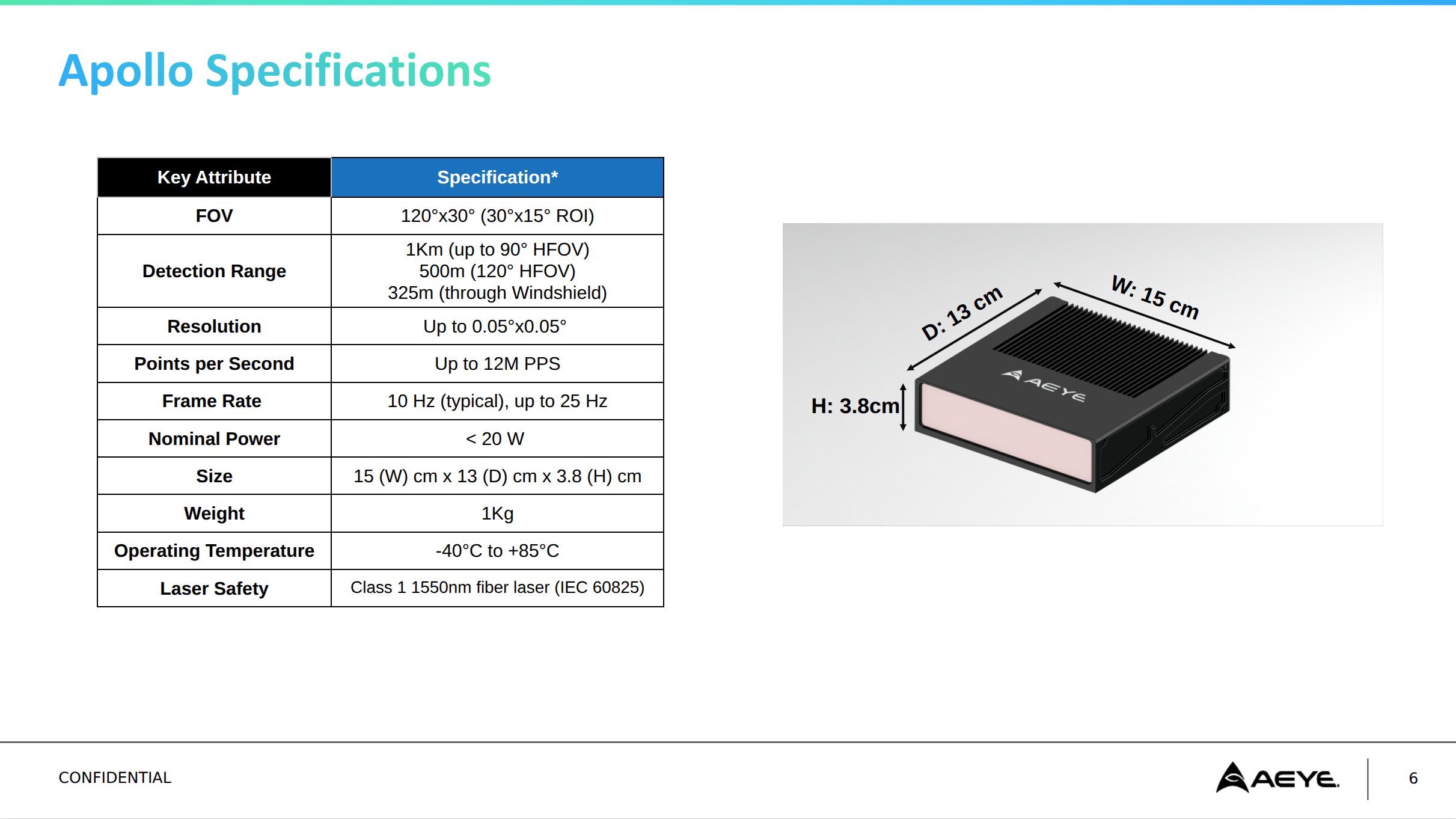
Key features include dynamic scan patterns, ultra-long-range detection (up to one kilometer with Apollo), high resolution, adaptability to challenging environments (rain, darkness, fog), future-proof technology with over-the-air updates, and flexible mounting options. [Source]
How does AEye's software-defined lidar technology benefit users?
AEye's software-defined lidar allows for customization and scalability without hardware changes, enabling users to adapt the technology to specific applications and future requirements. [Source]
Does AEye's lidar perform well in adverse weather conditions?
Yes, AEye's lidar systems are engineered to perform reliably in challenging environments such as rain, darkness, and fog, ensuring consistent performance and operational reliability. [Source]
What integration options does AEye offer for OEMs?
AEye's Apollo 4Sight supports integration behind the windshield, on the roof, or in the grille, allowing OEMs to implement critical safety features with minimal impact on vehicle design. [Source]
What platforms is AEye's lidar integrated with?
AEye's Apollo sensor is fully integrated with the NVIDIA DRIVE AGX platform, including NVIDIA AGX DRIVE Thor™, combining long-range lidar perception with advanced AI compute capabilities. [Source]
Product Information
What products does AEye offer?
AEye offers Apollo (flagship lidar with up to one kilometer detection), OPTIS™ (full-stack 3D perception and action platform), and the 4Sight Intelligent Sensing Platform (precise measurement imaging for autonomous vehicles, smart infrastructure, and logistics). [Source]
Where can I find technical documentation for AEye's products?
Technical documentation, including specification sheets, white papers, and case studies, is available on AEye's resources page. For Apollo's detailed specs, see the Apollo spec sheet.
What is OPTIS™ and how does it support logistics operations?
OPTIS™ is a full-stack solution that provides high-resolution 3D perception and real-time action. For logistics, it offers point cloud precision to monitor busy areas, prevent incursions, track assets, and coordinate movement, with configurable detection zones and low-latency, edge-processed insights. [Source]
What is the 4Sight Intelligent Sensing Platform?
The 4Sight Intelligent Sensing Platform delivers precise measurement imaging for applications such as autonomous vehicles, smart infrastructure, and logistics, enhancing safety, efficiency, and adaptability. [Source]
Use Cases & Benefits
What industries use AEye's lidar technology?
Industries include automotive, trucking, smart infrastructure, aviation, defense, rail, and logistics. Case studies demonstrate applications in safety, asset tracking, and operational efficiency. [Source]
Can you share examples of AEye's lidar in real-world use cases?
Yes. Examples include pedestrian detection in challenging scenarios (A Pedestrian in Headlights), obstacle avoidance, false positive reduction, abrupt stop detection, and cargo protrusion detection. See the ITS case studies for more.
How does AEye's lidar improve safety in autonomous vehicles?
AEye's lidar enables early detection, better perception, and faster reaction times, improving safety in autonomous driving. Case studies like A Pedestrian in Headlights and Flatbed Trailer Across Roadway highlight these benefits.
How does AEye's lidar support smart infrastructure projects?
AEye's lidar enhances connected environments and infrastructure projects by providing high-resolution, real-time perception for intelligent transportation systems (ITS) and smart city applications. [Source]
What are the benefits of AEye's lidar for logistics operations?
AEye's lidar improves operational efficiency and safety in logistics by enabling real-time object and area tracking, configurable detection zones, and integration with existing SOPs. [Source]
Competition & Comparison
How does AEye compare to Velodyne?
Velodyne offers traditional lidar with fixed scan patterns, while AEye provides dynamic scan patterns, software-defined architecture, and over-the-air updates. AEye's approach allows for greater customization, adaptability, and future-proofing. [Source]
How does AEye compare to Luminar?
Luminar focuses on long-range, hardware-centric lidar, while AEye offers dynamic scan patterns, adaptability to challenging environments, and flexible mounting options. AEye's software-defined approach enables more customization and reliable performance in adverse conditions. [Source]
How does AEye compare to Innoviz?
Innoviz offers solid-state lidar with limited software-defined customization. AEye's lidar is customizable without hardware changes, features over-the-air updates, and provides ultra-long-range detection and high resolution for demanding applications. [Source]
Why should a customer choose AEye over competitors?
Customers should consider AEye for its dynamic scan patterns, software-defined architecture, future-proof design, high performance, and flexible mounting options. These features provide scalability, adaptability, and efficiency across industries. [Source]
Technical Requirements & Implementation
How easy is it to implement AEye's lidar solutions?
AEye's products are designed for ease of integration with existing systems, supported by comprehensive technical support, validation testing tools, and user education resources. This ensures a smooth and efficient onboarding process. [Source]
What support does AEye provide during implementation?
AEye offers direct technical support, extensive training resources, and validation testing tools to help customers quickly and confidently adopt its products. [Source]
Resources & Learning Materials
Where can I find AEye's resource library?
AEye's resource library, including white papers, case studies, technical documentation, and videos, is available at https://www.aeye.ai/resources/.
What types of resources does AEye provide?
AEye provides case studies, white papers, technical specification sheets, videos, news updates, and press releases. These materials help users understand the technology, applications, and industry impact. [Source]
Where can I find case studies about AEye's lidar technology?
Case studies are available on AEye's resources page, including documents like Lidar Case Studies for ITS Use Cases.
What learning materials are available in AEye's resources section?
The resources section contains white papers (e.g., on the Four “Rs” of LiDAR), videos, case studies, and technical documentation to help users understand AEye's technology and its applications. [Source]
Customer Proof & Partnerships
Who are some of AEye's customers and partners?
Notable customers and partners include Continental (volume production), Sanmina Corporation (manufacturing for non-automotive markets), and NVIDIA (integration with NVIDIA DRIVE platform). [Source]
What feedback have customers given about AEye's ease of use?
Customers benefit from AEye's ease of integration, comprehensive technical support, user education resources, and validation testing tools, making onboarding smooth and efficient. [Source]