Frequently Asked Questions

Product Information: Apollo Sensor & AEye Solutions

What is AEye's Apollo sensor and why was it selected by a major OEM?

The Apollo sensor is AEye's flagship high-performance 1550nm lidar sensor, capable of detecting objects at distances up to one kilometer. It was selected by a major transportation OEM for its unmatched long-range detection, enabling faster hazard identification and response time. This selection represents a potential million revenue opportunity over the next 24 to 36 months and validates Apollo's industry-leading performance for advanced safety systems. [Source]

What are the key features of the Apollo lidar sensor?

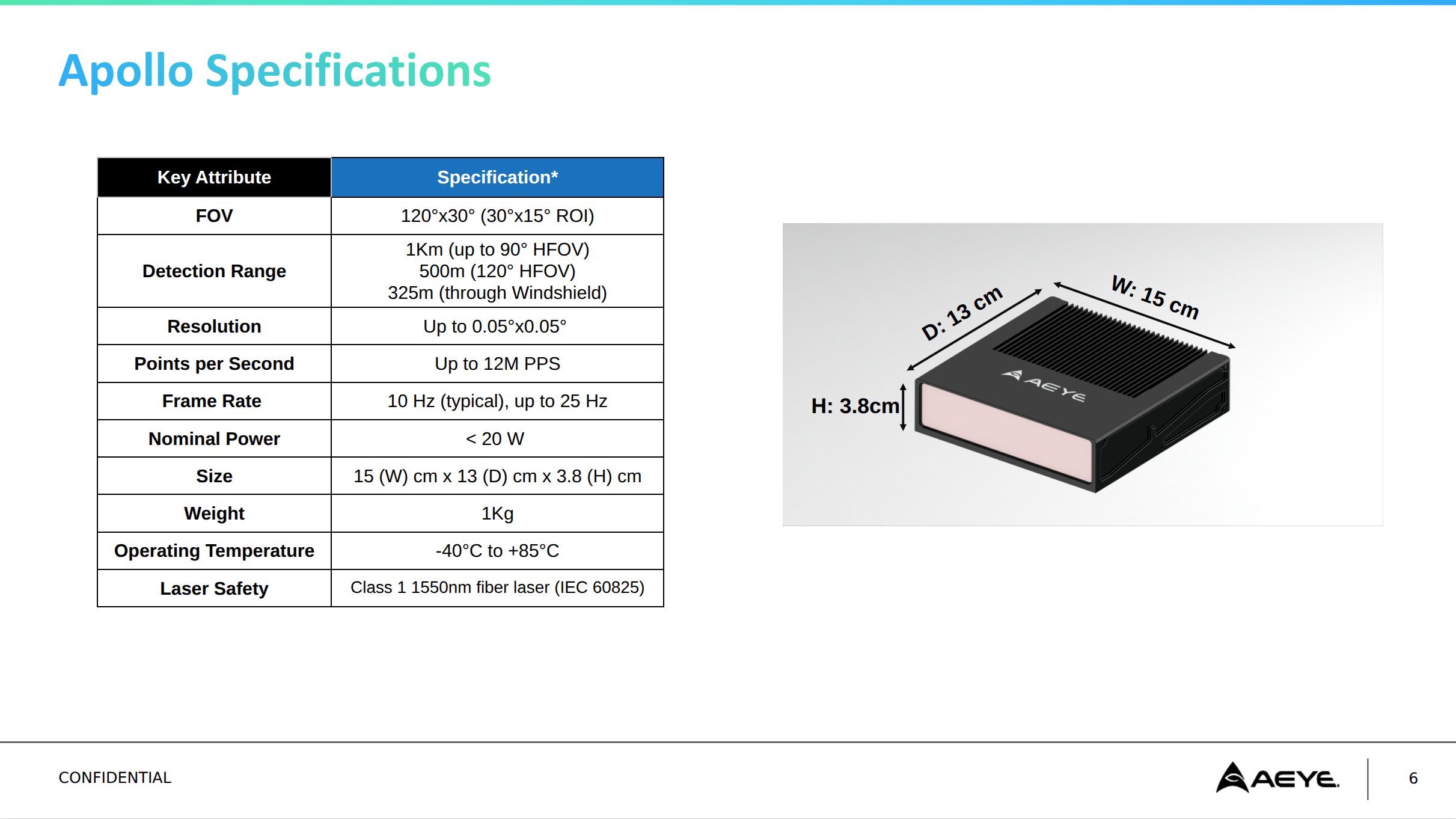
Apollo offers ultra-long-range detection (up to 1 km), exceptional resolution, a compact and power-efficient form factor, and flexible deployment options for both vehicles and fixed infrastructure. It is designed to support advanced driver-assistance systems (ADAS), autonomous vehicles, and intelligent transportation systems. [Source]

What products and services does AEye offer?

AEye provides advanced lidar solutions including Apollo (long-range lidar), OPTIS (full-stack 3D perception and action system), and the 4Sight Intelligent Sensing Platform. These products are used in automotive, smart infrastructure, logistics, defense, and more. [Source]

What is software-defined lidar technology?

AEye's software-defined lidar allows for real-time customization and scalability without hardware changes. This enables users to adapt the sensor's performance to specific applications and environments, ensuring long-term relevance through over-the-air updates. [Source]

What technical documentation is available for Apollo?

Detailed specification sheets for Apollo are available for download. These documents provide in-depth technical data on performance, range, resolution, and integration options. Download Apollo Spec Sheet

What is the purpose of AEye's press releases page?

The press releases page serves as an archive for official announcements, updates, and financial results related to AEye's activities and achievements. View Press Releases

Where can I find AEye's recent press releases?

Recent press releases, including financial results, event participation, and product updates, are available at https://www.aeye.ai/press-releases/.

What forward-looking statements are included in AEye's press releases?

Forward-looking statements may include expectations about product performance, revenue opportunities, business plans, and industry trends. These statements are based on current assumptions and are subject to risks and uncertainties as detailed in AEye's SEC filings. [Source]

How can I contact AEye for investor relations inquiries?

For investor relations, contact AEye, Inc. at [email protected] or call +1 (925) 400-4366. Agency contact: Evan Niu, CFA, Financial Profiles, Inc., [email protected], 310-622-8243. [Source]

What is AEye's company address?

AEye, Inc. is located at 4670 Willow Road, Suite 125, Pleasanton, CA 94588, USA. [Source]

How does Apollo support advanced driver-assistance and intelligent transportation systems?

Apollo's long-range detection and high resolution enable early object identification, which is critical for advanced driver-assistance systems (ADAS) and intelligent transportation systems. Its flexible deployment supports both vehicle and infrastructure integration. [Source]

What are the risks associated with AEye's forward-looking statements?

Risks include potential changes in OEM programs, product performance, timing, lidar adoption rates, regulatory changes, and competitive industry dynamics. These risks are detailed in AEye's SEC filings and forward-looking statement disclaimers. [Source]

How does AEye's Apollo sensor compare to traditional lidar systems?

Apollo offers dynamic scan patterns, ultra-long-range detection (up to 1 km), and software-defined customization, setting it apart from traditional fixed-pattern lidar systems. These features enable superior safety and adaptability for advanced applications. [Source]

What is the expected revenue opportunity from the major OEM selection?

The selection of Apollo by a major transportation OEM represents a potential revenue opportunity of million or more, anticipated over the next 24 to 36 months. [Source]

What industries use AEye's lidar solutions?

Industries include automotive, trucking, smart infrastructure, aviation, defense, rail, and logistics. AEye's technology is used for safety, autonomy, and operational efficiency across these sectors. [Source]

Who are some of AEye's notable customers and partners?

Notable customers and partners include Continental (automotive), Sanmina Corporation (manufacturing), and NVIDIA (AI and autonomous driving platforms). [Source]

What integrations does AEye support?

AEye's Apollo sensor is integrated with the NVIDIA DRIVE AGX platform, including NVIDIA AGX DRIVE Thor™, and supports OEM integration options behind the windshield, on the roof, or in the grille. [Source]

How does AEye's lidar technology perform in challenging environments?

AEye's lidar systems are engineered for reliable performance in adverse conditions such as rain, darkness, and fog, ensuring consistent detection and operational reliability. [Source]

What are some real-world use cases for AEye's lidar technology?

Use cases include pedestrian detection in challenging scenarios, obstacle avoidance, false positive reduction, abrupt stop detection, and adapting to new challenges through software updates. Case studies are available on AEye's resources page. [Source]

How does AEye's lidar compare to competitors like Velodyne, Luminar, and Innoviz?

AEye differentiates itself with dynamic scan patterns, software-defined architecture, future-proof design (over-the-air updates), and high performance. Competitors may offer fixed scan patterns or limited software customization. [Source]

What customer feedback has AEye received regarding ease of use?

Customers benefit from ease of integration, comprehensive technical support, user education, and validation testing tools, making onboarding smooth and efficient. [Source]

How long does it take to implement AEye's solutions?

Implementation timelines vary by use case, but AEye prioritizes quick integration with extensive support and validation tools to ensure a fast and confident start. [Source]

What case studies demonstrate AEye's lidar in action?

Case studies include 'A Pedestrian in Headlights', 'Flatbed Trailer Across Roadway', 'Obstacle Avoidance', 'False Positive', and 'Cargo Protruding from Vehicle', illustrating safety, adaptability, and efficiency. [Source]

What pain points does AEye solve for transportation and mobility?

AEye addresses early hazard detection, adaptability to challenging environments, operational efficiency, and future-proofing through software updates, supporting safer and more efficient transportation systems. [Source]

What makes AEye's lidar technology future-proof?

Over-the-air updates allow AEye's lidar to adapt to evolving requirements and new challenges without hardware changes, reducing obsolescence risk and ensuring long-term value. [Source]

How does AEye support OEMs and system integrators?

AEye provides flexible integration options, technical support, and validation tools to help OEMs and system integrators deploy lidar solutions efficiently and effectively. [Source]

Where can I find case studies for intelligent transportation systems (ITS)?

Case studies for ITS use cases are available in the downloadable document Lidar Case Studies for ITS Use Cases.

What white papers are available to learn more about AEye's lidar technology?

White papers include 'Rethinking the Four Rs of LiDAR', 'Time of Flight vs. FMCW LiDAR', and 'AEye iDAR: Sensor Performance Validation Report (VSI Labs)'. These are available on AEye's resources page. [Source]

How does AEye's lidar help reduce false positives in detection?

AEye's lidar uses high-resolution measurement imaging and dynamic scan patterns to differentiate between real and false obstacles, reducing unnecessary braking or maneuvers. [Source]

What are the benefits of AEye's compact lidar design?

The compact design allows for flexible placement (in-cabin, roof, grille), supporting diverse integration needs and minimizing impact on vehicle or infrastructure design. [Source]

How does AEye ensure its technology remains relevant as requirements evolve?

Through software-defined architecture and over-the-air updates, AEye's lidar can adapt to new requirements and use cases without hardware changes, ensuring long-term relevance. [Source]

What support resources does AEye provide for new customers?

AEye offers technical support, training resources, documentation, tutorials, and hands-on sessions to help customers integrate and validate lidar solutions efficiently. [Source]

AEye Reports Fourth Quarter and Full-Year 2025 Results; Strengthened Foundation for Commercial Growth Read more AEye Joining NVIDIA Halos AI Systems Inspection Lab to Advance Safety-Certified Physical AI Solutions Read more AEye Reports Fourth Quarter and Full-Year 2025 Results; Strengthened Foundation for Commercial Growth Read more AEye Joining NVIDIA Halos AI Systems Inspection Lab to Advance Safety-Certified Physical AI Solutions Read more

AEye’s Apollo Sensor Selected by Major OEM Unlocking Potential $30M Revenue Opportunity

PLEASANTON, Calif. – (BUSINESS WIRE) – June 30, 2025 – AEye, Inc. (Nasdaq: LIDR), a global leader in adaptive, high-performance lidar solutions, today announced that its Apollo lidar units have been selected by a major transportation OEM, representing a potential revenue opportunity of $30 million or more anticipated over the next 24 to 36 months. The OEM selected AEye specifically for Apollo’s unmatched ability to detect objects at up to one kilometer, enabling faster hazard identification and response time. This selection marks a major milestone in advancing long-range safety systems for transportation applications where early object detection is critical.

“Apollo’s ability to detect objects at one kilometer continues to set the standard for lidar performance. Many critical transportation applications require perception well beyond 200 meters, and we believe this selection by a global OEM validates the growing role of lidar in sensing applications that depend on extended range and reliability. We’re proud to support this industry leader in deploying the next generation of intelligent safety systems,” said AEye CEO Matt Fisch.

About AEye

AEye is the provider of unique software-defined lidar solutions that enable advanced driver-assistance, vehicle autonomy, smart infrastructure, and logistics applications that save lives and propel the future of transportation and mobility. Its latest sensor, Apollo, is a high-performance 1550nm lidar sensor capable of detecting objects at distances of up to one kilometer, and delivers exceptional resolution in a compact, power-efficient, and cost-effective form factor. Designed for flexible deployment, Apollo integrates into vehicles as well as fixed infrastructure to support both ADAS and intelligent transportation systems and is ideal for dynamic applications which require precise measurement imaging to ensure safety and performance.

Forward-Looking Statements

Certain statements included in this press release that are not historical facts are forward-looking statements within the meaning of the federal securities laws, including the safe harbor provisions under the United States Private Securities Litigation Reform Act of 1995. Forward-looking statements are sometimes accompanied by words such as “believe,” “continue,” “project,” “expect,” “anticipate,” “estimate,” “intend,” “strategy,” “future,” “opportunity,” “predict,” “plan,” “may,” “should,” “will,” “would,” “potential,” “seem,” “seek,” “outlook,” and similar expressions that predict or indicate future events or trends, or that are not statements of historical matters. Forward-looking statements are predictions, projections, and other statements about future events that are based on current expectations and assumptions and, as a result, are subject to risks and uncertainties. Forward-looking statements in this press release include, without limitation, statements about the potential revenue that may be generated from the selection of AEye’s Apollo lidar by this major transportation OEM and the time in which such revenue is expected to be realized, among others. These statements are based on various assumptions, whether or not identified in this press release. These forward-looking statements are provided for illustrative purposes only and are not intended to serve as and must not be relied on by an investor as a guarantee, an assurance, a prediction, or a definitive statement of fact or probability. Actual events and circumstances are very difficult or impossible to predict and will differ from the assumptions. Many actual events and circumstances are beyond the control of AEye. Many factors could cause actual future events to differ from the forward-looking statements in this press release, including but not limited to: (i) the risks that the $30 million revenue opportunity may not be realized, in whole or in part, due to changes in the program by the major transportation OEM, the performance of the lidar sensor, or otherwise; (ii) the risks that the $30 million revenue opportunity may not be realized within the next 24 to 36 months, in whole or in part, due to timing changes by the major transportation OEM, or otherwise; (iii) the risks that lidar adoption may occur slower than anticipated or fail to occur at all; (iv) the risks that AEye’s products may not meet the diverse range of performance and functional requirements of target markets and customers; (v) the risks that AEye’s products may not function as anticipated by AEye, or by target markets and customers; (vi) the risks that AEye may not be in a position to adequately or timely address either the near or long-term opportunities that may or may not exist in the evolving autonomous transportation industry; (vii) the risks that laws and regulations are adopted impacting the use of lidar that AEye is unable to comply with, in whole or in part; (viii) the risks associated with changes in competitive and regulated industries in which AEye operates, variations in operating performance across competitors, and changes in laws and regulations affecting AEye’s business; (ix) the risks that AEye is unable to adequately implement its business plans, forecasts, and other expectations, and identify and realize additional opportunities; and (x) the risks of economic downturns and a changing regulatory landscape in the highly competitive and evolving industry in which AEye operates. These risks and uncertainties may be amplified by current or future global conflicts and current and potential trade restrictions, trade tensions, and tariffs, all of which continue to cause economic uncertainty. You should carefully consider the foregoing factors and the other risks and uncertainties described in the “Risk Factors” section of the periodic report that AEye has most recently filed with the U.S. Securities and Exchange Commission, or the SEC, and other documents filed by us or that will be filed by us from time to time with the SEC. These filings identify and address other important risks and uncertainties that could cause actual events and results to differ materially from those contained in the forward-looking statements. Forward-looking statements speak only as of the date they are made.

Investors are cautioned not to put undue reliance on forward-looking statements; AEye assumes no obligation and does not intend to update or revise these forward-looking statements, whether as a result of new information, future events, or otherwise. AEye gives no assurance that AEye will achieve any of its expectations.

Investor Relations Contacts

Agency Contact

Financial Profiles, Inc.
Evan Niu, CFA
[email protected]
310-622-8243

Company Contact

AEye, Inc. Investor Relations
[email protected]
925-400-4366