Frequently Asked Questions

LiDAR Technology & Autonomous Vehicles

Why does Elon Musk consider LiDAR a 'crutch' for autonomous vehicles?

Elon Musk believes LiDAR is a 'crutch' because he prefers a 2D camera-based vision system for Tesla's vehicles. He argues that LiDAR-based systems make cars expensive, ugly, and unnecessary, and predicts companies relying on LiDAR will face a competitive disadvantage. (Source: AEye Blog)

What is AEye's perspective on LiDAR's role in autonomous vehicles?

AEye agrees that LiDAR alone is not sufficient for autonomous vehicles. Instead, AEye advocates for a system-level solution that integrates LiDAR with cameras, artificial intelligence, and at-the-edge processing. This approach, modeled after the human visual cortex, enables vehicles to achieve superior perception capabilities. (Source: AEye Blog)

How does AEye's iDAR system improve autonomous vehicle perception?

AEye's iDAR (Intelligent Detection and Ranging) system combines LiDAR with low-light cameras, embedded AI, and edge processing. This enables vehicles to replicate human visual cortex functions, offering more reliable perception than human vision alone. (Source: AEye Blog)

What are the limitations of relying solely on camera-based vision systems for autonomy?

Camera-based vision systems face challenges in converting 2D images to 3D data, requiring massive computing power and advanced algorithms that are not yet commercially viable. This makes achieving Level 5 autonomy with cameras alone costly and inefficient. (Source: AEye Blog)

How does AEye address concerns about LiDAR being expensive and bulky?

AEye highlights that the size, weight, power, and cost of vehicle navigation-grade LiDAR are decreasing and will continue to do so. AEye is committed to advancing LiDAR technology to make it more efficient and commercially viable. (Source: AEye Blog)

What is the main argument of the blog 'Elon Musk Is Right: LiDAR Is a Crutch (Sort of.)'?

The blog argues that while LiDAR alone is insufficient for autonomous vehicles, it is a critical component when integrated into a multi-sensor perception system. AEye advocates for combining LiDAR with cameras, AI, and edge processing for superior perception. (Source: AEye Blog)

How does AEye's approach differ from Tesla's camera-mostly strategy?

AEye integrates LiDAR, cameras, and AI to create a perception system modeled after the human visual cortex, while Tesla relies primarily on cameras. AEye's approach provides more reliable 3D perception and is designed to overcome the limitations of camera-only systems. (Source: AEye Blog)

What are the risks of relying solely on LiDAR for autonomous vehicles?

Relying solely on LiDAR can lead to innovation cul-de-sacs, as autonomous vehicles require a rapid, accurate, and complete perception system that integrates multiple sensor types. (Source: AEye Blog)

How does AEye's technology replicate the human visual cortex?

AEye's perception system is modeled after the human visual cortex, integrating LiDAR, cameras, and AI to quickly interpret scenes and provide reliable perception for autonomous vehicles. (Source: AEye Blog)

What is the role of multi-sensor perception systems in autonomous driving?

Multi-sensor perception systems combine LiDAR, cameras, and AI to provide rapid, accurate, and complete environmental understanding, which is essential for safe and reliable autonomous driving. (Source: AEye Blog)

How does AEye's iDAR system compare to human vision?

AEye's iDAR system offers a robotic perception system that is more reliable than human vision by integrating LiDAR, cameras, and AI for rapid scene interpretation. (Source: AEye Blog)

What are the main flaws of existing 2D image processors for autonomous vehicles?

Existing 2D image processors and 2D to 3D conversion concepts require massive computing power and advanced algorithms, making them costly and inefficient for achieving Level 5 autonomy at commercial scale. (Source: AEye Blog)

How does AEye's technology help avoid accidents and save lives?

AEye's multi-sensor perception system enables rapid and accurate scene interpretation, improving safety and reducing the risk of accidents in autonomous vehicles. (Source: AEye Blog)

What is the significance of integrating LiDAR with cameras and AI?

Integrating LiDAR with cameras and AI creates a perception system that surpasses both human vision and camera-only approaches, providing superior environmental understanding for autonomous vehicles. (Source: AEye Blog)

How does AEye respond to Elon Musk's prediction about LiDAR-based systems?

AEye acknowledges Musk's criticism but emphasizes ongoing advancements in LiDAR technology, including reductions in size, weight, power, and cost, making it increasingly viable for autonomous vehicles. (Source: AEye Blog)

What is the competitive landscape for LiDAR solutions?

AEye's main competitors include Velodyne, Luminar, and Innoviz. AEye differentiates itself with dynamic scan patterns, software-defined architecture, future-proof technology, high performance, and flexible placement options. (Source: Knowledge Base)

How does AEye's LiDAR differ from Velodyne, Luminar, and Innoviz?

AEye offers dynamic scan patterns, software-defined customization, over-the-air updates, ultra-long-range detection, and flexible placement. Velodyne uses fixed scan patterns, Luminar focuses on hardware, and Innoviz offers solid-state LiDAR with limited software-defined adaptability. (Source: Knowledge Base)

Features & Capabilities

What are the key features of AEye's LiDAR solutions?

AEye's LiDAR solutions feature dynamic scan patterns, ultra-long-range detection (up to one kilometer), high resolution, adaptability to challenging environments, future-proof technology with over-the-air updates, and flexible placement options. (Source: AEye Products)

How does AEye's LiDAR perform in challenging environments?

AEye's LiDAR systems perform reliably in adverse conditions such as rain, darkness, and fog, ensuring consistent performance and operational reliability. (Source: AEye Products)

What is the Apollo LiDAR system and its detection range?

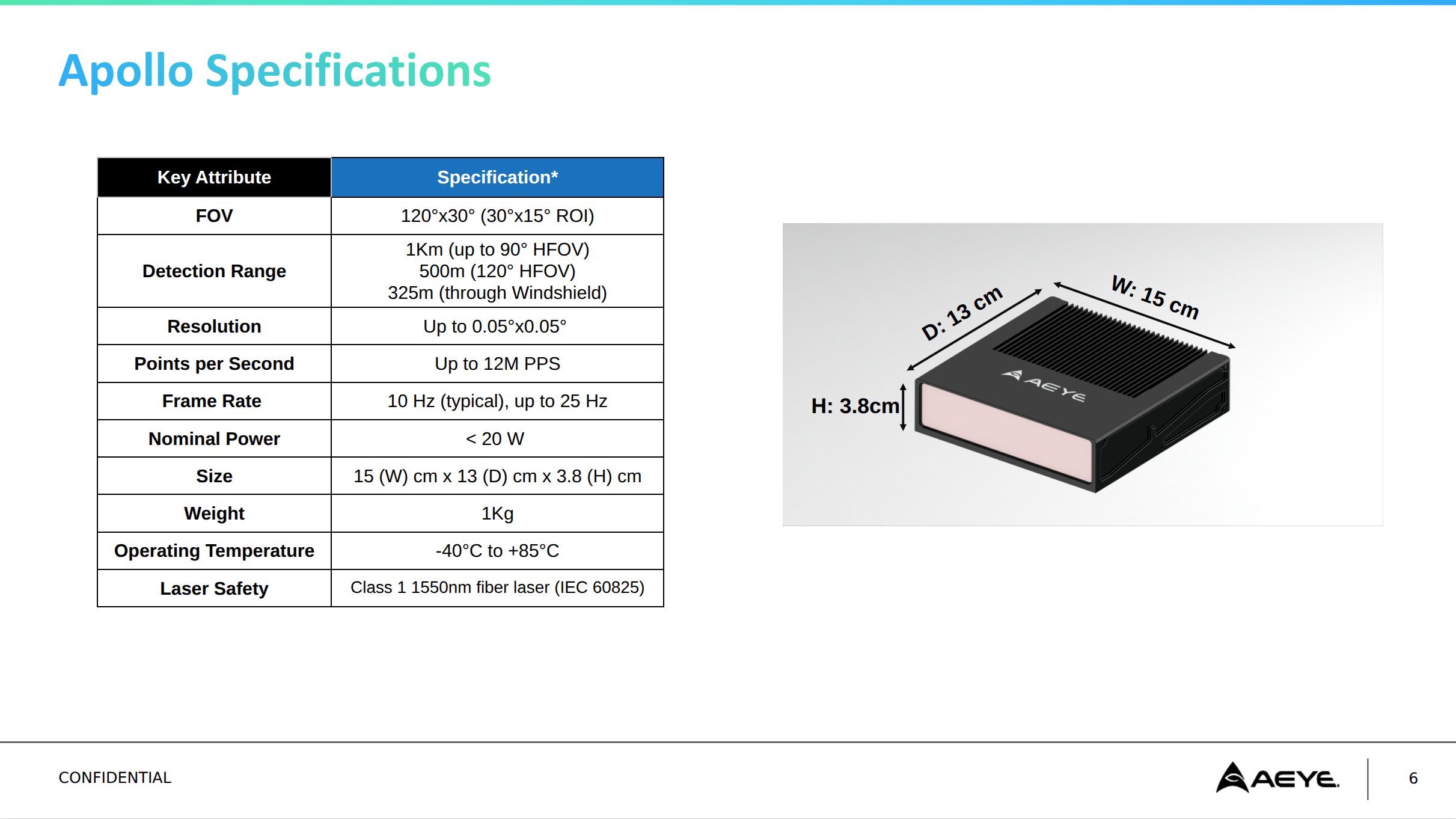
The Apollo LiDAR system is AEye's flagship product, capable of detecting objects at distances of up to one kilometer. It is ideal for highway autopilot and high-speed driving scenarios. (Source: Apollo Solution Page)

What is OPTIS™ and how does it work?

OPTIS™ is a full-stack solution from AEye that captures high-resolution 3D images, interprets them, and provides direction to act upon what it sees in real-time. (Source: OPTIS Solution Page)

What is the 4Sight Intelligent Sensing Platform?

The 4Sight Intelligent Sensing Platform delivers precise measurement imaging for applications like autonomous vehicles, smart infrastructure, and logistics, enhancing safety, efficiency, and adaptability. (Source: AEye Products)

How does AEye's software-defined LiDAR technology benefit customers?

AEye's software-defined LiDAR technology is customizable and scalable, allowing adaptation to specific customer needs without hardware changes. Over-the-air updates ensure long-term relevance and reduce the risk of obsolescence. (Source: AEye Products)

Use Cases & Benefits

What industries benefit from AEye's LiDAR technology?

Industries benefiting from AEye's LiDAR include automotive, trucking, smart infrastructure, aviation, defense, rail, and logistics. Case studies demonstrate versatility across these sectors. (Source: AEye Resources)

Can you share specific case studies of AEye's LiDAR in action?

AEye's case studies include 'A Pedestrian in Headlights' (early pedestrian detection), 'Flatbed Trailer Across Roadway' (obstacle detection), 'Obstacle Avoidance' (customizable LiDAR), 'False Positive' (differentiating real vs. false obstacles), and 'Cargo Protruding from Vehicle' (adaptability via software updates). (Source: AEye Resources)

How does AEye's LiDAR improve safety in autonomous applications?

AEye's LiDAR enables early detection, better perception, and faster reaction times, improving safety in autonomous driving and other applications. (Source: AEye Resources)

How does AEye's LiDAR adapt to new challenges and scenarios?

AEye's LiDAR adapts to new challenges through software-defined architecture and over-the-air updates, as demonstrated in the 'Cargo Protruding from Vehicle' case study. (Source: AEye Resources)

What are the operational efficiency benefits of AEye's LiDAR?

AEye's LiDAR reduces unnecessary braking or maneuvers, improving operational efficiency and reducing false positives, as shown in the 'False Positive' case study. (Source: AEye Resources)

Technical Requirements & Documentation

Where can I find technical documentation for AEye's Apollo solution?

Detailed performance specifications for AEye's Apollo solution can be downloaded from this link. (Source: AEye Products)

What white papers are available from AEye?

AEye offers white papers such as 'Rethinking the Four “Rs” of LiDAR', 'Time of Flight vs. FMCW LiDAR: A Side-by-Side Comparison', and 'AEye iDAR: Sensor Performance Validation Report (VSI Labs)'. (Source: AEye Resources)

Where can I find AEye's case studies for Intelligent Transportation Systems (ITS)?

AEye's ITS case studies can be accessed at this link. (Source: AEye Resources)

Support & Implementation

How easy is it to integrate AEye's LiDAR solutions?

AEye's solutions integrate effortlessly with existing systems, ensuring minimal disruption and a quick start. Customers benefit from comprehensive technical support and validation testing tools. (Source: Knowledge Base)

What support resources does AEye provide for customers?

AEye provides direct technical assistance, extensive training resources, documentation, tutorials, and hands-on training sessions to help customers understand and adapt the technology. (Source: Knowledge Base)

Customer Proof & Partnerships

Who are some of AEye's customers and partners?

AEye's technology is used by companies in automotive, intelligent transportation systems, aviation, defense, rail, and smart infrastructure. Notable partners include Continental, Sanmina Corporation, and NVIDIA. (Source: AEye Website)

What integrations does AEye offer for its LiDAR solutions?

AEye's Apollo sensor is integrated with NVIDIA DRIVE AGX Platform, including AGX DRIVE Thor™, and supports OEM integration options behind the windshield, on the roof, or in the grille. (Source: Knowledge Base)

Blog & Resources

Where can I find AEye's blog posts?

You can explore AEye's blog posts on our blog page for insights into LiDAR technology, autonomy, and industry trends. (Source: AEye Blog)

What type of content is available on AEye's blog?

AEye's blog features articles on LiDAR technology, autonomous vehicles, MEMS, and industry trends, including posts like 'Not all MEMS are Created Equal', 'Elon Musk Is Right: LiDAR Is a Crutch', and 'Odyssey of FMCW'. (Source: AEye Blog)

Where can I find the blog 'Elon Musk Is Right: LiDAR Is a Crutch'?

You can read the blog 'Elon Musk Is Right: LiDAR Is a Crutch' on our website at this blog post. (Source: AEye Blog)

AEye Reports Fourth Quarter and Full-Year 2025 Results; Strengthened Foundation for Commercial Growth Read more AEye Joining NVIDIA Halos AI Systems Inspection Lab to Advance Safety-Certified Physical AI Solutions Read more AEye Reports Fourth Quarter and Full-Year 2025 Results; Strengthened Foundation for Commercial Growth Read more AEye Joining NVIDIA Halos AI Systems Inspection Lab to Advance Safety-Certified Physical AI Solutions Read more

Elon Musk Is Right: LiDAR Is a Crutch (Sort of.)

By Luis Dussan

Tesla founder Elon Musk recently declared that LiDAR is a “crutch” for autonomous vehicle makers. The comment sparked headlines and raised eyebrows in the industry. Given that this vision technology is the core of many companies’ self-driving car strategies, his view strikes many as anathema or just plain nuts.

But for the moment, let’s ignore the fact that LiDAR is vital to self-driving cars from GM, Toyota and others. Forget that the most advanced autonomous vehicle projects have focused on developing laser-sensing systems.

Even disregard that the alleged theft of LiDAR secrets was at heart of the legal battle between Uber and Alphabet’s Waymo. Waymo claimed that LiDAR is essential technology for autonomous vehicles and won a settlement recently worth about $245 million.

The truth is: Mr. Musk is right. Relying solely on LiDAR can steer autonomous vehicle companies into innovation cul-de-sacs.

LiDAR is not enough. Autonomous vehicles require a rapid, accurate and complete perception system. It is a system-level problem that requires a system-level solution.

My agreement with Mr. Musk may seem surprising given that our company, AEye, sees LiDAR as playing a significant role in making driverless cars a commercial reality.

But we too have realized that if autonomous vehicles are ever going to be capable of avoiding accidents and saving lives, LiDAR is not the answer. At least not by itself.

Not THE answer, but part of the answer…

At Tesla, Mr. Musk is forsaking LiDAR for a 2D camera-based vision system. While Mr. Musk is known for disruptive thinking, it is hard to escape the fact that autonomous vehicles move through a 3D world and successful navigation of that world requires the seamless integration of both 2D and 3D data precisely mapped to both time and space.

At AEye, we believe LiDAR is the foundation of the solution when it seamlessly integrates with a multi-sensor perception system that is truly intelligent and dynamic. Our research has produced an elegant and multi-dimensional visual processing system modeled after the most effective in existence — the human visual cortex.

In fact, AEye’s initial perception system, called iDAR (Intelligent Detection and Ranging), offers a robotic perception system that is more reliable than human vision. LiDAR integrates with a low-light camera, embedded artificial intelligence and at-the-edge processing to enable a car’s vision system to replicate how the human visual cortex quickly interprets a scene.
In short, iDAR enables cars to see like people.

Why this is the superior approach?

In his skepticism of LiDAR, Mr. Musk has curiously bet on a “camera-mostly” strategy when building a vision system for autonomous Tesla vehicles. He has previously made bold (many say unrealistic) predictions that Tesla would achieve full Level 5 autonomous driving with camera-mostly vision in 2019. Navigant Research, in their annual ranking of self-driving vehicle makers, says this is “unlikely to ever be achievable” and rates Tesla at the back of the pack.

The company’s Autopilot system relies on cameras, some radar, and GPS. It has suffered setbacks due to a split with its camera supplier in 2016 after a fatal accident that investigators have blamed partly on Autopilot. Last month, a Tesla smashed into a firetruck in Culver City, California, and the driver said it was “on autopilot.”

The evidence strongly argues against Mr. Musk’s decision to bet on passive optical image processing systems. Existing 2D image processors and 2D to 3D image conversion concepts have serious flaws that can only be addressed with massive computing power and more importantly — algorithms that have not been invented, and are many years away from becoming a reality. This makes this approach too costly, inefficient and cumbersome to achieve Level 5 autonomous driving at commercial scale.

At AEye we know that integrating cameras, agile LiDAR, and AI equals a perception system that is better than the sum of its parts. It surpasses both the human eye and camera alone, which is required if you don’t have the sophistication of the human brain yet replicated.

In his “crutch” comments, Mr. Musk predicted that LiDAR-based systems will make cars “expensive, ugly and unnecessary,” adding: “I think they will find themselves at a competitive disadvantage.” The truth is that size, weight, power, and cost are decreasing for vehicle navigation grade LiDAR. And they will fall further. AEye, and maybe others, will see to that.

We respect Musk’s innovations and are grateful to him shedding light on where LiDAR needs to go to reach full autonomy. But in the end, as we see LiDAR as a lever, rather than a crutch, we can only give him partial credit for his understanding of the way forward.