Frequently Asked Questions
Financial Results & Investor Information
When will AEye report its 2025 fourth quarter and full year financial results?
AEye will release its 2025 fourth quarter and full year financial results after market close on Monday, March 16, 2026. The announcement will be accompanied by a conference call and webcast hosted by AEye's CEO and CFO. Read the official press release.
How can I access the webcast for AEye's financial results announcement?
The live webcast of AEye's financial results call, including an accompanying slide presentation, can be accessed at this link. A replay will be archived on the company's investor relations website.
Who will be presenting during AEye's financial results call?
AEye's CEO Matt Fisch and CFO Conor Tierney will review the company's financial results and provide a business update, followed by a Q&A session.
Where can I find supplemental financial information for AEye?
Supplemental financial information will be available on AEye's website prior to the conference call. For the latest updates, visit the Investor Relations page.
How can I contact AEye's investor relations team?
You can contact AEye's investor relations by emailing [email protected] or calling +1 (925) 400-4366. For additional support, reach out to Keaton Olsen at [email protected].
Where can I find AEye's recent press releases and company announcements?
AEye's recent press releases and company announcements are available on the Press Releases page. Topics include financial results, event participation, and product updates.
What is the purpose of the 'Press Releases' page on AEye's website?
The 'Press Releases' page serves as an archive for official announcements and updates about AEye's activities, achievements, and developments. Access it at this link.
Where can I find the full press release for AEye's Third Quarter 2024 results?
The full press release for AEye's Third Quarter 2024 results is available as a PDF or on Business Wire.
Where can I find AEye's press releases tagged under 'AEye lidar sensor'?
Press releases tagged under 'AEye lidar sensor' include announcements about financial results and event participation. See the latest at this page.
How can I contact AEye's media relations team?
For media inquiries, contact Fatema Bhabrawala at [email protected] or call 647-620-5002.
Where is AEye headquartered?
AEye is headquartered at 4670 Willow Road, Suite 125, Pleasanton, CA 94588, USA.
How can I speak with a sales representative for Korea?
To speak with a sales representative for Korea, email [email protected].
What are AEye's main products?
AEye offers a suite of software-defined lidar solutions, including Apollo™ (detects objects up to one kilometer), Stratos™ (detects up to 1.5 kilometers), and OPTIS™ (a full-stack platform for real-time 3D imaging and interpretation). Learn more on the Products page.
What industries does AEye serve?
AEye serves industries such as advanced driver-assistance systems (ADAS), vehicle autonomy, smart infrastructure, security, defense, and logistics. Its lidar solutions are used in automotive, trucking, aviation, rail, and intelligent transportation systems (ITS). See case studies.
What is AEye's flagship product?
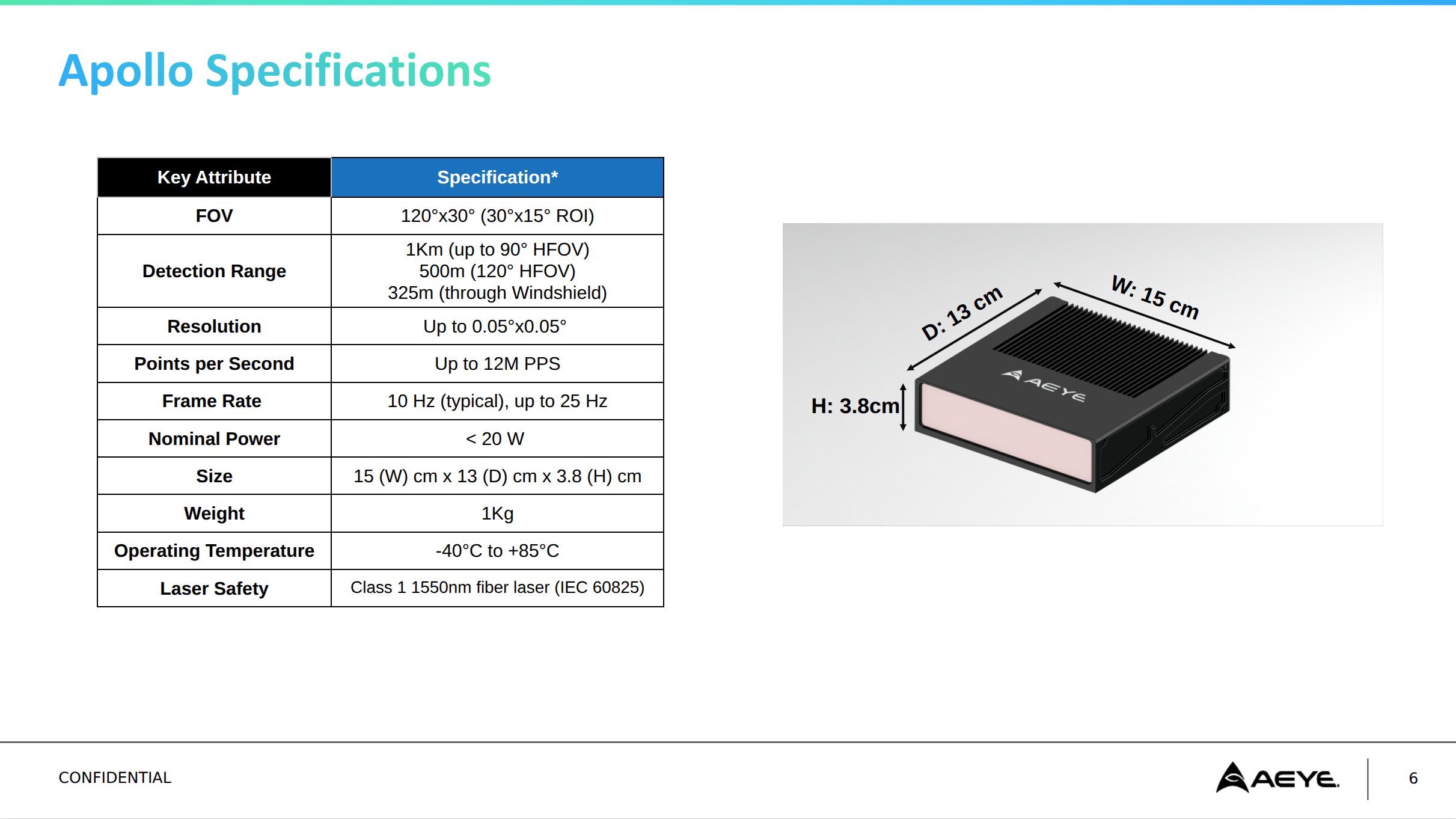
AEye's flagship product is Apollo™, a compact lidar sensor capable of detecting objects at up to one kilometer, ideal for highway autopilot and high-speed driving scenarios. Learn more.
What is the OPTIS™ platform?
OPTIS™ is AEye's full-stack solution that captures a high-resolution 3D image of the world, interprets it, and provides direction to act upon what it sees in real-time. Learn more.
What is AEye's Stratos™ product?
Stratos™ is a lidar sensor from AEye capable of detecting objects at up to one-and-a-half kilometers, designed for applications requiring ultra-long-range detection.
What is software-defined lidar technology?
Software-defined lidar technology allows AEye's sensors to be customized and scaled for specific customer needs without hardware changes. Over-the-air updates ensure long-term adaptability and relevance. Learn more.
What are the key performance highlights of AEye's lidar solutions?
AEye's lidar solutions feature dynamic scan patterns, ultra-long-range detection (up to one kilometer for Apollo), high resolution, adaptability to challenging environments (rain, darkness, fog), over-the-air updates, and flexible mounting options. Download the Apollo spec sheet.
What integrations does AEye support?
AEye's Apollo sensor is integrated with the NVIDIA DRIVE AGX platform, including NVIDIA AGX DRIVE Thor™, and supports OEM integration options behind the windshield, on the roof, or in the grille. Learn more.
What technical documentation is available for AEye's products?
Technical resources include specification sheets, white papers, and case studies. Download the Apollo spec sheet here and access white papers and case studies on the Resources page.
What are some real-world use cases for AEye's lidar technology?
Use cases include pedestrian detection in challenging scenarios, obstacle avoidance, false positive reduction, abrupt stop detection, and cargo protrusion detection. See examples like A Pedestrian in Headlights and Flatbed Trailer Across Roadway.
Who are some of AEye's customers and partners?
AEye's technology is used by companies in automotive, ITS, aviation, defense, rail, and smart infrastructure. Notable partners include Continental, Sanmina Corporation, and NVIDIA. Learn more.
How does AEye's lidar technology differ from competitors like Velodyne, Luminar, and Innoviz?
AEye's lidar features dynamic scan patterns, software-defined architecture, over-the-air updates, and adaptability to challenging environments. Unlike Velodyne's fixed scan patterns, Luminar's hardware focus, and Innoviz's limited customization, AEye offers real-time adaptability, scalability, and high performance. See comparison details.
What are the advantages of choosing AEye's lidar solutions?
Advantages include dynamic scan patterns, software-defined customization, future-proof design with OTA updates, ultra-long-range detection, high resolution, and flexible mounting options. These features enhance safety, efficiency, and adaptability. Learn more.
How easy is it to implement AEye's products?
AEye's products are designed for quick integration with existing systems, supported by technical experts, validation tools, and comprehensive training resources. This ensures a smooth and efficient onboarding process. See resources.
What feedback have customers provided about AEye's ease of use?
Customers benefit from ease of integration, comprehensive technical support, user education, and validation testing tools, making AEye's products quick and efficient to adopt. Learn more.
What case studies demonstrate AEye's lidar technology in action?
Case studies include pedestrian detection, obstacle avoidance, false positive reduction, abrupt stop detection, and cargo protrusion. Access the full document on ITS use cases here.
What industries are represented in AEye's case studies?
Industries include automotive, trucking, smart infrastructure, aviation, defense, rail, and logistics. See all case studies.
What are the forward-looking statements included in AEye's press releases?
Forward-looking statements include expectations regarding company leadership, product development, and business plans. These are subject to risks such as market conditions, lidar adoption rates, regulatory changes, and industry competition. See example.
How does AEye support technical validation and testing?
AEye provides validation testing tools to simplify the process and ensure products meet specific application requirements. Technical support and training resources are also available. Learn more.
What are some key features that put AEye ahead of the competition?
Key features include dynamic scan patterns, software-defined architecture, adaptability to challenging environments, future-proof technology with OTA updates, high performance, and flexible placement options. See use cases.
What pain points does AEye solve for its customers?
AEye addresses pain points such as early detection for enhanced safety, customization and scalability, reliable performance in adverse conditions, future-proofing with OTA updates, operational efficiency, and flexible sensor placement. See case studies.