Frequently Asked Questions

LiDAR Technology & Autonomous Vehicles

Why does Elon Musk consider LiDAR a 'crutch' for autonomous vehicles?

Elon Musk believes LiDAR is a 'crutch' because he prefers a 2D camera-based vision system for Tesla's vehicles. He argues that LiDAR-based systems make cars expensive, ugly, and unnecessary, and predicts companies relying on LiDAR will face a competitive disadvantage. (Source: AEye Blog)

What is AEye's perspective on LiDAR's role in autonomous vehicles?

AEye agrees that LiDAR alone is not sufficient for autonomous vehicles. Instead, AEye advocates for a system-level solution that integrates LiDAR with cameras, artificial intelligence, and at-the-edge processing. This approach, modeled after the human visual cortex, enables vehicles to achieve superior perception capabilities. (Source: AEye Blog)

How does AEye's iDAR system improve autonomous vehicle perception?

AEye's iDAR (Intelligent Detection and Ranging) system combines LiDAR with low-light cameras, embedded AI, and edge processing. This enables vehicles to replicate human visual cortex functions, offering more reliable perception than human vision alone. (Source: AEye Blog)

What are the limitations of relying solely on camera-based vision systems for autonomy?

Camera-based vision systems face challenges in converting 2D images to 3D data, requiring massive computing power and advanced algorithms that are not yet commercially viable. This makes achieving Level 5 autonomy with cameras alone costly and inefficient. (Source: AEye Blog)

How does AEye address concerns about LiDAR being expensive and bulky?

AEye highlights that the size, weight, power, and cost of vehicle navigation-grade LiDAR are decreasing and will continue to do so. AEye is committed to advancing LiDAR technology to make it more efficient and commercially viable. (Source: AEye Blog)

What is the main argument of the blog 'Elon Musk Is Right: LiDAR Is a Crutch (Sort of.)'?

The blog argues that while LiDAR alone is insufficient for autonomous vehicles, it is a critical component when integrated into a multi-sensor perception system. AEye advocates for combining LiDAR with cameras, AI, and edge processing for superior perception. (Source: AEye Blog)

How does AEye's approach differ from Tesla's camera-mostly strategy?

AEye integrates LiDAR, cameras, and AI to create a perception system modeled after the human visual cortex, while Tesla relies primarily on cameras. AEye's approach provides more reliable 3D perception and is designed to overcome the limitations of camera-only systems. (Source: AEye Blog)

What are the risks of relying solely on LiDAR for autonomous vehicles?

Relying solely on LiDAR can lead to innovation cul-de-sacs, as autonomous vehicles require a rapid, accurate, and complete perception system that integrates multiple sensor types. (Source: AEye Blog)

How does AEye's technology replicate the human visual cortex?

AEye's perception system is modeled after the human visual cortex, integrating LiDAR, cameras, and AI to quickly interpret scenes and provide reliable perception for autonomous vehicles. (Source: AEye Blog)

What is the role of multi-sensor perception systems in autonomous driving?

Multi-sensor perception systems combine LiDAR, cameras, and AI to provide rapid, accurate, and complete environmental understanding, which is essential for safe and reliable autonomous driving. (Source: AEye Blog)

How does AEye's iDAR system compare to human vision?

AEye's iDAR system offers a robotic perception system that is more reliable than human vision by integrating LiDAR, cameras, and AI for rapid scene interpretation. (Source: AEye Blog)

What are the main flaws of existing 2D image processors for autonomous vehicles?

Existing 2D image processors and 2D to 3D conversion concepts require massive computing power and advanced algorithms, making them costly and inefficient for achieving Level 5 autonomy at commercial scale. (Source: AEye Blog)

How does AEye's technology help avoid accidents and save lives?

AEye's multi-sensor perception system enables rapid and accurate scene interpretation, improving safety and reducing the risk of accidents in autonomous vehicles. (Source: AEye Blog)

What is the significance of integrating LiDAR with cameras and AI?

Integrating LiDAR with cameras and AI creates a perception system that surpasses both human vision and camera-only approaches, providing superior environmental understanding for autonomous vehicles. (Source: AEye Blog)

How does AEye respond to Elon Musk's prediction about LiDAR-based systems?

AEye acknowledges Musk's criticism but emphasizes ongoing advancements in LiDAR technology, including reductions in size, weight, power, and cost, making it increasingly viable for autonomous vehicles. (Source: AEye Blog)

What is the competitive landscape for LiDAR solutions?

AEye's main competitors include Velodyne, Luminar, and Innoviz. AEye differentiates itself with dynamic scan patterns, software-defined architecture, future-proof technology, high performance, and flexible placement options. (Source: Knowledge Base)

How does AEye's LiDAR differ from Velodyne, Luminar, and Innoviz?

AEye offers dynamic scan patterns, software-defined customization, over-the-air updates, ultra-long-range detection, and flexible placement. Velodyne uses fixed scan patterns, Luminar focuses on hardware, and Innoviz offers solid-state LiDAR with limited software-defined adaptability. (Source: Knowledge Base)

Features & Capabilities

What are the key features of AEye's LiDAR solutions?

AEye's LiDAR solutions feature dynamic scan patterns, ultra-long-range detection (up to one kilometer), high resolution, adaptability to challenging environments, future-proof technology with over-the-air updates, and flexible placement options. (Source: AEye Products)

How does AEye's LiDAR perform in challenging environments?

AEye's LiDAR systems perform reliably in adverse conditions such as rain, darkness, and fog, ensuring consistent performance and operational reliability. (Source: AEye Products)

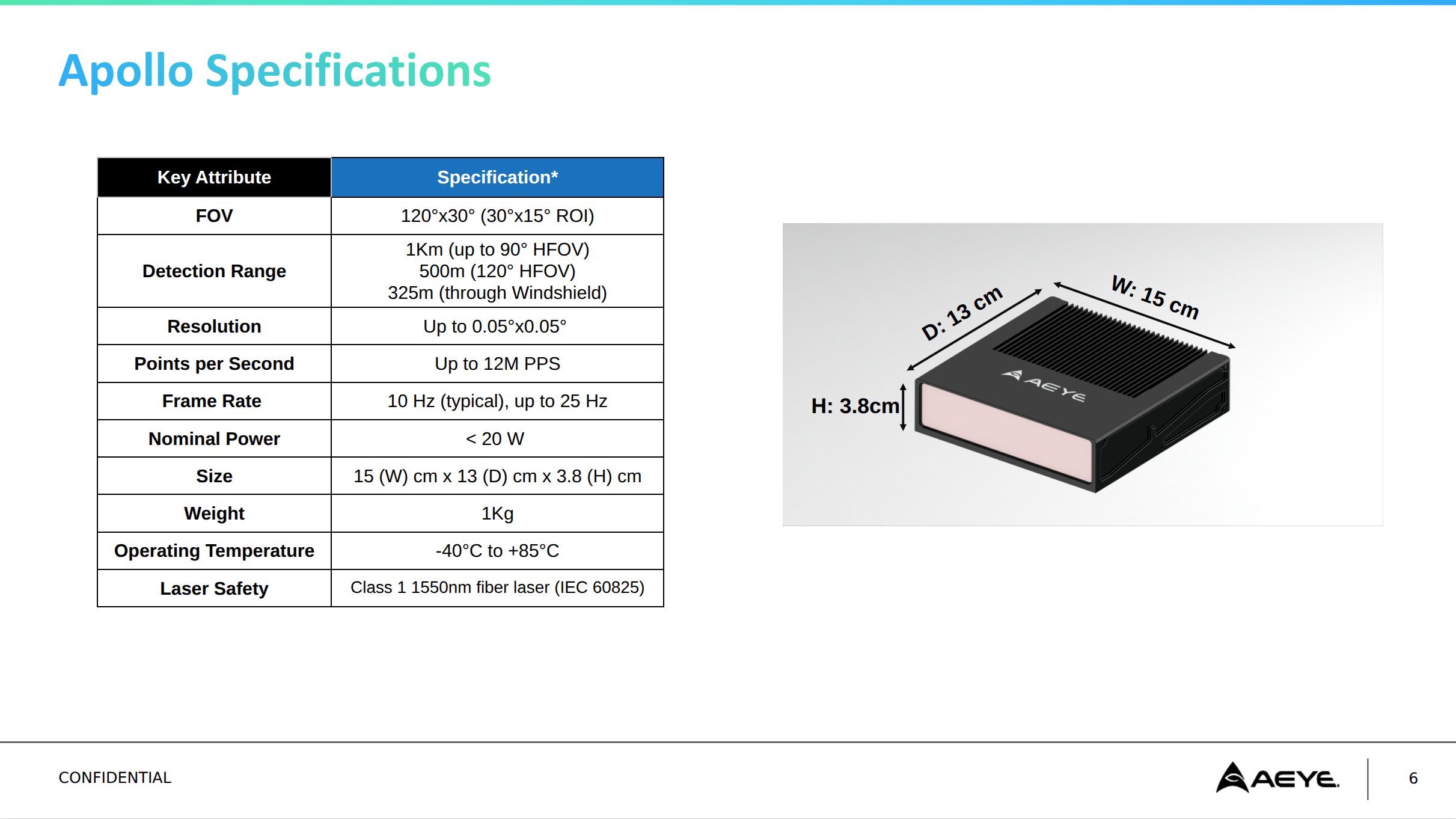
What is the Apollo LiDAR system and its detection range?

The Apollo LiDAR system is AEye's flagship product, capable of detecting objects at distances of up to one kilometer. It is ideal for highway autopilot and high-speed driving scenarios. (Source: Apollo Solution Page)

What is OPTIS™ and how does it work?

OPTIS™ is a full-stack solution from AEye that captures high-resolution 3D images, interprets them, and provides direction to act upon what it sees in real-time. (Source: OPTIS Solution Page)

What is the 4Sight Intelligent Sensing Platform?

The 4Sight Intelligent Sensing Platform delivers precise measurement imaging for applications like autonomous vehicles, smart infrastructure, and logistics, enhancing safety, efficiency, and adaptability. (Source: AEye Products)

How does AEye's software-defined LiDAR technology benefit customers?

AEye's software-defined LiDAR technology is customizable and scalable, allowing adaptation to specific customer needs without hardware changes. Over-the-air updates ensure long-term relevance and reduce the risk of obsolescence. (Source: AEye Products)

Use Cases & Benefits

What industries benefit from AEye's LiDAR technology?

Industries benefiting from AEye's LiDAR include automotive, trucking, smart infrastructure, aviation, defense, rail, and logistics. Case studies demonstrate versatility across these sectors. (Source: AEye Resources)

Can you share specific case studies of AEye's LiDAR in action?

AEye's case studies include 'A Pedestrian in Headlights' (early pedestrian detection), 'Flatbed Trailer Across Roadway' (obstacle detection), 'Obstacle Avoidance' (customizable LiDAR), 'False Positive' (differentiating real vs. false obstacles), and 'Cargo Protruding from Vehicle' (adaptability via software updates). (Source: AEye Resources)

How does AEye's LiDAR improve safety in autonomous applications?

AEye's LiDAR enables early detection, better perception, and faster reaction times, improving safety in autonomous driving and other applications. (Source: AEye Resources)

How does AEye's LiDAR adapt to new challenges and scenarios?

AEye's LiDAR adapts to new challenges through software-defined architecture and over-the-air updates, as demonstrated in the 'Cargo Protruding from Vehicle' case study. (Source: AEye Resources)

What are the operational efficiency benefits of AEye's LiDAR?

AEye's LiDAR reduces unnecessary braking or maneuvers, improving operational efficiency and reducing false positives, as shown in the 'False Positive' case study. (Source: AEye Resources)

Technical Requirements & Documentation

Where can I find technical documentation for AEye's Apollo solution?

Detailed performance specifications for AEye's Apollo solution can be downloaded from this link. (Source: AEye Products)

What white papers are available from AEye?

AEye offers white papers such as 'Rethinking the Four “Rs” of LiDAR', 'Time of Flight vs. FMCW LiDAR: A Side-by-Side Comparison', and 'AEye iDAR: Sensor Performance Validation Report (VSI Labs)'. (Source: AEye Resources)

Where can I find AEye's case studies for Intelligent Transportation Systems (ITS)?

AEye's ITS case studies can be accessed at this link. (Source: AEye Resources)

Support & Implementation

How easy is it to integrate AEye's LiDAR solutions?

AEye's solutions integrate effortlessly with existing systems, ensuring minimal disruption and a quick start. Customers benefit from comprehensive technical support and validation testing tools. (Source: Knowledge Base)

What support resources does AEye provide for customers?

AEye provides direct technical assistance, extensive training resources, documentation, tutorials, and hands-on training sessions to help customers understand and adapt the technology. (Source: Knowledge Base)

Customer Proof & Partnerships

Who are some of AEye's customers and partners?

AEye's technology is used by companies in automotive, intelligent transportation systems, aviation, defense, rail, and smart infrastructure. Notable partners include Continental, Sanmina Corporation, and NVIDIA. (Source: AEye Website)

What integrations does AEye offer for its LiDAR solutions?

AEye's Apollo sensor is integrated with NVIDIA DRIVE AGX Platform, including AGX DRIVE Thor™, and supports OEM integration options behind the windshield, on the roof, or in the grille. (Source: Knowledge Base)

Blog & Resources

Where can I find AEye's blog posts?

You can explore AEye's blog posts on our blog page for insights into LiDAR technology, autonomy, and industry trends. (Source: AEye Blog)

What type of content is available on AEye's blog?

AEye's blog features articles on LiDAR technology, autonomous vehicles, MEMS, and industry trends, including posts like 'Not all MEMS are Created Equal', 'Elon Musk Is Right: LiDAR Is a Crutch', and 'Odyssey of FMCW'. (Source: AEye Blog)

Where can I find the blog 'Elon Musk Is Right: LiDAR Is a Crutch'?

You can read the blog 'Elon Musk Is Right: LiDAR Is a Crutch' on our website at this blog post. (Source: AEye Blog)

AEye Appoints Laura Wrisley as Chief Revenue Officer Read more Alive3D Selects AEye’s Apollo for Next-Generation Sports Analytics Read more AEye Apollo™ Lidar Validated on NVIDIA DRIVE AGX Thor™ Read more

Elon Musk and the Lidar Debate: What Comes Next?

Article edited 06/25/2026

For years, the autonomous vehicle industry was consumed by a debate: cameras versus lidar, lidar versus radar, vision-only versus sensor fusion. 

Few voices were louder than Elon Musk’s. In 2019, Musk famously referred to lidar as a “crutch” and a “fool’s errand”, arguing that camera-based systems alone would ultimately be sufficient for autonomous driving. 

At the time, the comment sparked endless debate across the automotive and technology industries. Supporters of lidar argued that precise 3D measurements were essential for safe autonomy. Vision-only advocates countered that cameras, combined with increasingly powerful AI, could provide all the information a vehicle needed to navigate the world. Years later, however, the conversation has evolved. 

The question is no longer whether vehicles should use lidar, radar, cameras, or some combination of sensors. Instead, the industry is increasingly focused on a more important challenge: how sensing, AI, and computers work together to help machines safely understand and interact with the physical world. 

The future is not about choosing a single sensor. It’s about building perception systems capable of delivering reliable, real-time understanding of complex environments. 

The Debate Was Never Really About Lidar 

The original lidar debate was often framed as a technology competition. 

Would cameras win? Would lidar win? Would radar eventually become the dominant sensing technology? The reality is that autonomy has always been a perception challenge. 

Before a vehicle can make a decision, change lanes, avoid a hazard, or protect a pedestrian, it must first understand what is happening around it. That understanding depends on the quality of the information available to the system. 

Different sensing technologies contribute different types of information. 

Cameras provide rich visual detail. Radar offers robust velocity detection and performs well in challenging environmental conditions. Lidar delivers precise 3D spatial measurements and accurate distance information. Each plays a role. 

The challenge is not selecting a winner. The challenge is creating a complete, reliable understanding of the environment. 

The Rise of Physical AI 

The evolution of the autonomy industry mirrors a much broader trend: the rise of Physical AI. 

For the past decade, much of AI’s growth occurred in digital environments. Large language models, recommendation engines, and analytics platforms processed information and generated outputs inside software systems. Today, AI is increasingly moving into the physical world. 

Vehicles, transportation infrastructure, robotics systems, logistics hubs, airports, rail networks, and industrial facilities are all becoming intelligent systems capable of perceiving, reasoning, and acting in real time. This is the essence of Physical AI. Before a machine can make an intelligent decision, however, it must first understand the environment around it. Perception becomes foundational. Without accurate perception, even the most advanced AI models are operating with incomplete information. 

Why the Conversation Has Changed 

The autonomous systems of today are fundamentally different from those being discussed when the lidar debate first began.  

Modern platforms increasingly rely on: 

-Multiple sensing technologies 

-Centralized AI compute architectures 

-Software-defined systems 

-Real-time perception and analytics 

-Continuous software improvement 

As these systems become more capable, the focus shifts from individual sensors to overall system performance. The goal is no longer to determine whether a camera, radar, or lidar is superior in isolation. The goal is to create the safest, most reliable perception system possible. That requires understanding not only what each sensor does well, but how they work together. 

Why Lidar Continues to Matter 

While the industry has moved beyond sensor wars, lidar continues to play an important role in enabling real-world perception. 

Unlike cameras, which infer distance from images, lidar directly measures distance using laser pulses to generate precise three-dimensional representations of the environment.  This provides valuable spatial awareness that can help systems understand object position, shape, movement, and distance with a high degree of accuracy. 

As Physical AI expands into increasingly complex environments, long-range perception becomes especially important. Earlier detection provides more time to evaluate situations, make decisions, and respond safely.  In transportation applications, additional awareness can translate directly into improved safety, operational efficiency, and confidence. 

What Comes Next? 

 As Physical AI continues expanding across transportation, infrastructure, aviation, logistics, and defense, perception will become one of the most important enabling technologies of the decade. 

The future belongs to systems that can see, understand, and act in the real world. To learn more about AEye’s Physical AI applications, visit our product pages.