

How Lidar Improves Railway Obstacle Detection and Rail Safety


Rail systems are an essential form of transportation around the world, but they also present unique safety challenges.
Unlike passenger vehicles, trains cannot quickly swerve or stop to avoid hazards. Their size, speed, and braking distances make early obstacle detection critically important.
Recent rail incidents and ongoing industry research continue to highlight the importance of improving railway obstacle detection and real-time situational awareness across modern rail infrastructure. Whether involving pedestrians, vehicles at crossings, debris on tracks, or operational hazards, many rail-related accidents share a common challenge: by the time an obstacle is identified, there may be very little time left to react.
As rail systems evolve toward greater automation and intelligence, advanced rail safety technology such as lidar is becoming increasingly important to improving operational awareness and safety outcomes.
Why Railway Obstacle Detection Is Challenging
Rail environments are fundamentally different from roadways. Trains require long stopping distances while operating at high speeds. They also often travel through low-visibility environments and share space with crossings, vehicles, pedestrians, and rail-road workers. Since they are confined to tracks, they do not have a way to easily maneuver around obstacles. All of these create scenarios where timing becomes critical.
At highway speeds, even a few additional seconds of awareness can dramatically improve a vehicle’s ability to respond safely. In rail environments, where braking distances can extend for miles depending on speed and load, early detection becomes even more important. The challenge is not simply identifying hazards, it is identifying them early enough to support meaningful operational decisions.
This is why train obstacle detection systems and intelligent perception technologies are receiving increased attention across the rail industry.
How Lidar Can Improve Rail Safety
Traditional railway safety systems often rely heavily on human visibility, fixed monitoring systems, cameras, radar, and reactive braking systems. While these technologies provide value, they can face limitations in low light, adverse weather, or complex environments where depth perception and spatial awareness are critical. This is where lidar offers unique advantages.
Unlike cameras, which interpret visual information, or radar, which provides lower-resolution environmental detail, lidar directly measures distance using laser pulses to generate precise three-dimensional representations of the environment in real time.
This enables rail lidar systems to detect objects earlier, better understand spatial relationships, identify potential hazards with greater accuracy, and operate more reliably in challenging weather. For rail systems, earlier detection can provide more reaction time, earlier operator alerts, and improved situational awareness.
In safety-critical transportation environments, time directly translates into safety.
Physical AI and Intelligent Rail Infrastructure
As transportation infrastructure becomes more intelligent, rail systems are beginning to evolve beyond traditional monitoring approaches.
The next generation of rail safety will increasingly depend on what many in the industry now describe as Physical AI, systems capable of perceiving, understanding, and responding to real-world environments in real time. This shift moves infrastructure from reactive to proactive.
Rather than responding only after a hazard is identified, intelligent perception systems can continuously monitor rail environments, identify anomalies earlier, and support safer operational decisions before incidents escalate.
Why Long-Range Perception Matters in Rail Applications
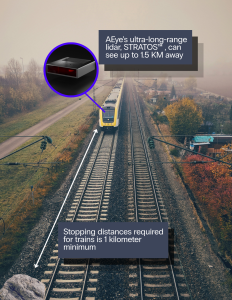
One of the biggest challenges in railway obstacle detection is visibility at distance. Stopping distances required for trains is about 800 meters, or 1 kilometer minimum when you include time for perception, both human and machine, to assess and validate that a detection is a legitimate obstacle.
Objects on or near tracks may be partially obstructed or difficult to identify until they are dangerously close. Weather, darkness, and environmental conditions can further reduce visibility.
Long-range perception helps address this challenge by enabling systems to identify potential hazards farther in advance.
At AEye, our software-defined lidar approach is designed around the principle that greater range provides more time to react.
Apollo™ delivers detection capabilities up to one kilometer, while STRATOS™ extends detection even further — up to 1.5 kilometers. This additional awareness can support earlier hazard identification and improved operational confidence across modern rail infrastructure safety systems.
Equally important, software-defined perception allows sensing systems to adapt to different operational requirements without requiring hardware redesigns, helping support evolving railway applications over time.
The Future of Rail Safety Technology
As railway AI systems, long-range sensing, and intelligent infrastructure continue to evolve, lidar is expected to play a growing role in helping rail operators improve safety and operational efficiency.
At AEye, we believe long-range, software-defined lidar will help enable the next generation of intelligent transportation infrastructure, supporting safer, smarter rail systems through advanced real-world perception.