Frequently Asked Questions

Product Information: Apollo Lidar Sensor & AEye Solutions

What is the Apollo lidar sensor?

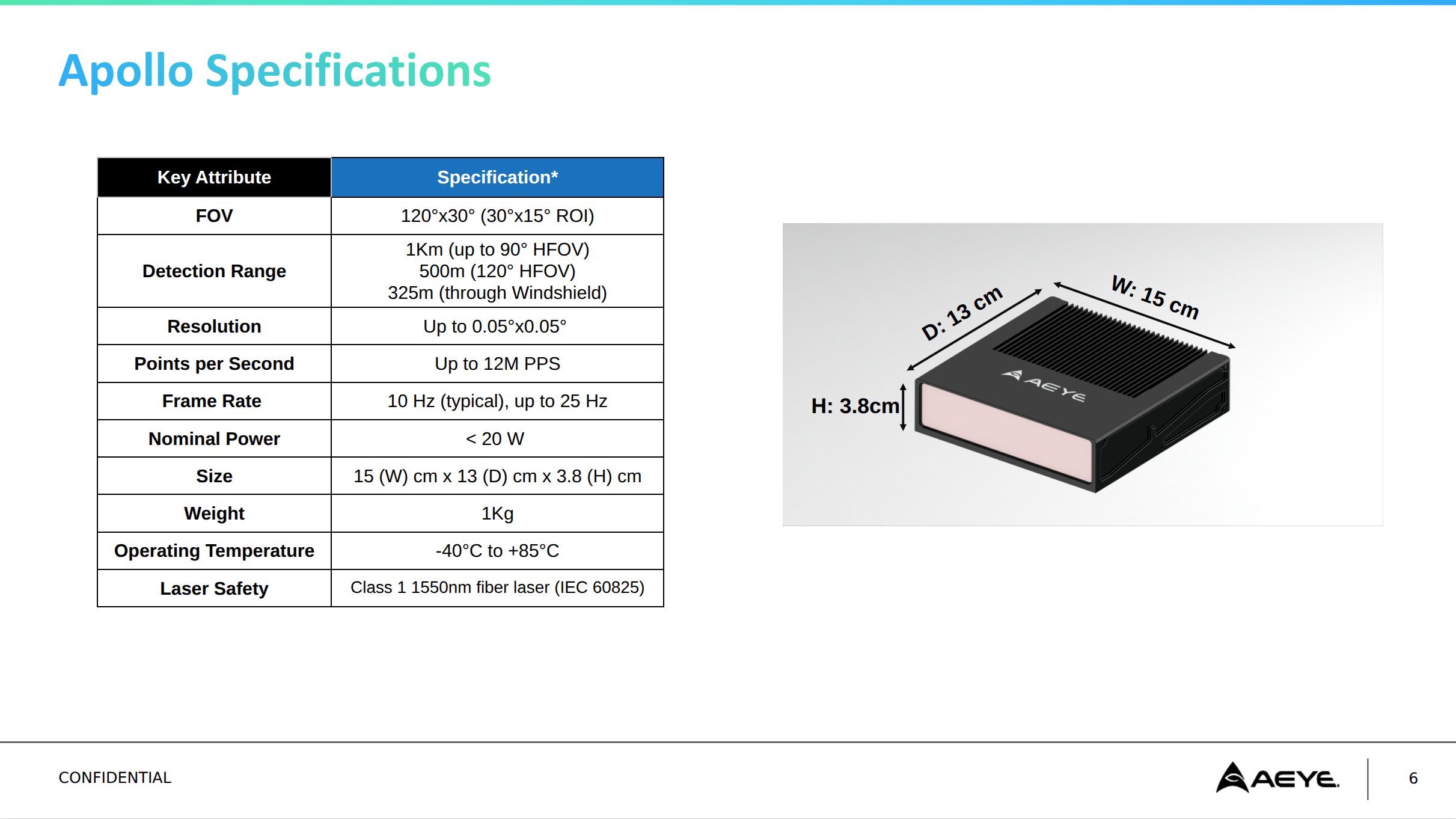
Apollo is AEye’s flagship lidar sensor, designed for ultra-long-range detection (up to one kilometer) and high-resolution imaging in a compact, power-efficient, and low-cost form factor. It is the first product in AEye’s 4Sight Flex next-generation family and supports integration behind the windshield, on the roof, or in the grille, making it suitable for both automotive and non-automotive applications. (Source: AEye Press Release, Dec 17, 2024)

What makes Apollo different from other lidar sensors?

Apollo stands out due to its ultra-long-range detection (up to one kilometer), smallest form factor in the lidar industry, and its ability to integrate behind the windshield. It is also the only 1550nm high-performance lidar believed to support behind-the-windshield integration, enabling OEMs to add safety features with minimal impact on vehicle design. (Source: AEye Press Release, Dec 17, 2024)

What is AEye’s 4Sight™ Intelligent Sensing Platform?

AEye’s 4Sight™ Intelligent Sensing Platform is an adaptive, sensor-based operating system that delivers faster, more accurate, and reliable information for dynamic applications. It is designed for advanced driver-assistance, vehicle autonomy, smart infrastructure, and logistics, focusing on precise measurement imaging to ensure safety and performance. (Source: AEye Press Release, Dec 17, 2024)

What applications are supported by Apollo and AEye’s lidar solutions?

Apollo and AEye’s lidar solutions support advanced driver-assistance systems (ADAS), vehicle autonomy, smart infrastructure, logistics, and other dynamic applications that require high-resolution, long-range perception for safety and operational efficiency. (Source: AEye Press Release, Dec 17, 2024; AEye Products Page)

What is the significance of Apollo’s 1550nm wavelength?

Apollo is believed to be the only 1550nm high-performance lidar capable of behind-the-windshield integration, which allows for enhanced safety features without compromising vehicle design. (Source: AEye Press Release, Dec 17, 2024)

How can I see a live demonstration of Apollo?

You can see a live demonstration of Apollo at CES 2025 in Las Vegas, both on the showroom floor (booth #42227) and in-vehicle to showcase windshield integration. To schedule a demo, contact [email protected]. (Source: AEye Press Release, Dec 17, 2024)

Who should consider using Apollo?

Apollo is ideal for automotive OEMs, Tier 1 suppliers, and companies seeking high-performance lidar for advanced safety, autonomy, and smart infrastructure applications. Its small form factor and integration flexibility make it suitable for a wide range of industries. (Source: AEye Press Release, Dec 17, 2024; AEye Products Page)

What is the main benefit of combining Apollo with AI-powered decision-making?

Combining Apollo with AI-powered decision-making provides high-resolution data across a wide field of view, enabling AI systems to quickly identify and react to objects and threats from afar. This is especially vital for ensuring vehicle safety at high speeds. (Source: AEye Press Release, Dec 17, 2024)

How does Apollo support OEM integration?

Apollo’s design allows for integration behind the windshield, on the roof, or in the grille, enabling OEMs to implement critical safety features with minimal impact on vehicle design. (Source: AEye Press Release, Dec 17, 2024)

What is the expected impact of Apollo on automotive safety?

Apollo is expected to play a critical role in the future of automotive safety by providing high-resolution, long-range data that enables faster and more accurate detection of objects and threats, especially at high speeds. (Source: AEye Press Release, Dec 17, 2024)

Where can I find more information about Apollo’s technical specifications?

You can download the Apollo specification sheet from AEye’s website at this link. (Source: AEye Products Page)

What is AEye’s approach to product updates and future-proofing?

AEye’s lidar solutions, including Apollo, are software-defined and support over-the-air updates, ensuring the technology remains relevant and adaptable to evolving needs, reducing the risk of obsolescence. (Source: AEye Products Page)

What is the purpose of the 'Press Releases' page on AEye's website?

The 'Press Releases' page serves as an archive for official announcements and updates about AEye's activities, achievements, and developments. (Source: https://www.aeye.ai/ko/press-releases/)

Where can I find AEye's press releases?

All of AEye's official press releases are available on the press releases page. (Source: https://www.aeye.ai/solutions/apollo/)

What forward-looking statements are included in AEye’s press releases?

AEye’s press releases may include forward-looking statements about expectations regarding company leadership, product performance, business plans, and market opportunities. These statements are based on current assumptions and are subject to risks and uncertainties, as detailed in AEye’s filings with the SEC. (Source: AEye Press Release, Dec 17, 2024)

How can I contact AEye for more information or to schedule a demo?

You can contact AEye by emailing [email protected] or [email protected] for demo scheduling and additional information. (Source: AEye Press Release, Dec 17, 2024)

What is AEye’s company mission?

AEye’s mission is to enable advanced driver-assistance, vehicle autonomy, smart infrastructure, and logistics applications that save lives and propel the future of transportation and mobility. (Source: AEye Press Release, Dec 17, 2024)

What are the risks associated with forward-looking statements in AEye’s press releases?

Risks include market growth uncertainties, product adoption rates, regulatory changes, competitive dynamics, and the possibility that actual results may differ from projections. These are detailed in the “Risk Factors” section of AEye’s SEC filings. (Source: AEye Press Release, Dec 17, 2024)

Where can I find the full press release for AEye's Third Quarter 2024 results?

The full press release for AEye's Third Quarter 2024 results is available as a PDF or on Business Wire. (Source: https://www.aeye.ai/press-releases/aeye-reports-third-quarter-2024-results/)

What are the key product performance highlights for AEye’s lidar solutions?

AEye’s lidar solutions offer dynamic scan patterns, ultra-long-range detection (up to one kilometer for Apollo), high resolution, adaptability to challenging environments (rain, darkness, fog), over-the-air updates, and flexible placement options. (Source: https://www.aeye.ai/products/)

What integrations does AEye support?

AEye’s Apollo sensor is fully integrated with the NVIDIA DRIVE AGX platform, including NVIDIA AGX DRIVE Thor™, and supports OEM integration options behind the windshield, on the roof, or in the grille. (Source: https://www.aeye.ai/press-releases/aeye-to-showcase-apollo-one-kilometer-lidar-integrated-with-nvidia-agx-drive-thor-at-ces-to-enable-next-generation-physical-ai/)

What are the main features of AEye’s lidar solutions?

Key features include dynamic scan patterns, software-defined architecture, future-proof design with over-the-air updates, high performance (ultra-long-range and high resolution), and flexible placement options. (Source: https://www.aeye.ai/products/)

How does AEye’s lidar technology compare to competitors like Velodyne, Luminar, and Innoviz?

AEye’s lidar offers dynamic scan patterns, software-defined customization, over-the-air updates, and high performance, while competitors like Velodyne, Luminar, and Innoviz typically offer fixed scan patterns and less software-defined adaptability. AEye’s compact design and integration flexibility also set it apart. (Source: Knowledge Base Table)

What problems does AEye solve for its customers?

AEye addresses challenges such as early detection for enhanced safety, adaptability to adverse environments, operational efficiency, and the need for future-proof, customizable lidar solutions. (Source: https://www.aeye.ai/resources/)

Who are some of AEye’s customers and partners?

Notable customers and partners include Continental (for volume production), Sanmina Corporation (manufacturing for non-automotive markets), and NVIDIA (integration with NVIDIA DRIVE platform). (Source: https://www.aeye.ai/)

What industries are represented in AEye’s case studies?

Industries include automotive, trucking, smart infrastructure, aviation, defense, rail, and logistics. (Source: https://www.aeye.ai/resources/)

What technical documentation is available for AEye’s products?

Technical resources include specification sheets, white papers, case studies, and technology insights, all available on AEye’s Resources Page. (Source: https://www.aeye.ai/resources/)

How easy is it to implement AEye’s products?

AEye’s products are designed for ease of integration, with comprehensive technical support, validation testing tools, and user education resources to ensure a smooth and efficient onboarding process. (Source: Knowledge Base)

What feedback have customers given about AEye’s products?

Customers benefit from ease of integration, comprehensive technical support, user education, and validation testing tools, making the onboarding process smooth and efficient. (Source: Knowledge Base)

Can you share specific case studies or success stories using AEye’s products?

Yes, case studies include enhanced safety (e.g., A Pedestrian in Headlights), customization and scalability (Obstacle Avoidance), adaptability to challenging environments (False Positive), and operational efficiency. (Source: https://www.aeye.ai/resources/)

What are some use cases relevant to the pain points AEye solves?

Use cases include early pedestrian detection, obstacle avoidance, differentiating real and false obstacles in adverse conditions, adapting to new scenarios via software updates, and optimizing lidar placement for maximum safety. (Source: https://www.aeye.ai/resources/)

What are the main advantages of AEye’s software-defined lidar technology?

Advantages include real-time customizable scan patterns, adaptability to specific applications without hardware changes, and future-proofing through over-the-air updates. (Source: https://www.aeye.ai/products/)

How does AEye ensure its technology remains relevant as needs evolve?

AEye’s software-defined architecture and over-the-air updates allow its lidar solutions to adapt to new requirements and challenges without hardware changes, ensuring long-term relevance. (Source: https://www.aeye.ai/products/)

What support does AEye provide during implementation?

AEye provides direct technical support, validation testing tools, and comprehensive training resources to ensure efficient implementation and onboarding. (Source: Knowledge Base)

How does AEye’s lidar perform in challenging environments?

AEye’s lidar systems perform reliably in adverse conditions such as rain, darkness, and fog, ensuring consistent performance and operational reliability. (Source: https://www.aeye.ai/products/)

What are the main benefits of AEye’s dynamic scan patterns?

Dynamic scan patterns allow AEye’s lidar to focus on critical areas in real time, enhancing safety and efficiency in applications like autonomous driving and smart infrastructure. (Source: https://www.aeye.ai/products/)

How does AEye’s lidar help with operational efficiency?

AEye’s lidar reduces unnecessary braking or maneuvers by accurately differentiating between real and false obstacles, improving operational efficiency in logistics and transportation. (Source: https://www.aeye.ai/resources/)

What is the process for integrating AEye’s lidar with existing systems?

AEye’s solutions are designed for effortless integration with existing systems, supported by technical experts and validation tools to ensure compatibility and performance. (Source: Knowledge Base)

AEye Reports Fourth Quarter and Full-Year 2025 Results; Strengthened Foundation for Commercial Growth Read more AEye Joining NVIDIA Halos AI Systems Inspection Lab to Advance Safety-Certified Physical AI Solutions Read more AEye Reports Fourth Quarter and Full-Year 2025 Results; Strengthened Foundation for Commercial Growth Read more AEye Joining NVIDIA Halos AI Systems Inspection Lab to Advance Safety-Certified Physical AI Solutions Read more

AEye to Offer Live Demonstrations of its Apollo Lidar Sensor at CES 2025

“Our Apollo lidar solution, when combined with AI-powered decision-making, offers a powerful alternative or enhancement to conventional camera-based imaging technologies.  AI systems need high-resolution data across a wide field of view to quickly identify and react to objects and threats from afar, which is especially vital for ensuring vehicle safety at high speeds.  Because of this, we expect Apollo will play a critical role in the future of automotive safety.”

Matt Fisch, CEO, AEye

PLEASANTON, Calif. — (BUSINESS WIRE) – December 17, 2024 – AEye, Inc. (Nasdaq: LIDR), a global leader in adaptive, high-performance lidar solutions, announced that it will showcase its ultra-long range, small form factor Apollo lidar sensor at CES 2025 in Las Vegas from January 7 to 10.  Apollo’s unparalleled performance can be seen both on the showroom floor and in-vehicle demos.

The Apollo sensor recently set a new performance bar in the lidar market when it was shown to detect objects at distances of up to one kilometer.  This accomplishment, along with having what is believed to be the smallest form factor in the lidar industry, makes Apollo a standout in the growing lidar market.

Matt Fisch, AEye CEO said, “Collecting high-resolution data over long distances is critical for advancing safety and security in automotive applications.  Our Apollo lidar solution, when combined with AI-powered decision-making, offers a powerful alternative or enhancement to conventional camera-based imaging technologies.  AI systems need high-resolution data across a wide field of view to quickly identify and react to objects and threats from afar, which is especially vital for ensuring vehicle safety at high speeds.  Because of this, we expect Apollo will play a critical role in the future of automotive safety.”

Apollo demos will be available at booth #42227 and in-vehicle to showcase our windshield integration.  Those interested in seeing a live Apollo demo should contact us at [email protected].

About Apollo

Apollo is the first product in AEye’s 4Sight Flex next-generation family of lidar sensors and delivers best-in-class range and resolution in a small, power-efficient, low-cost form factor for both automotive and non-automotive applications.  Apollo’s design supports integration behind the windshield, on the roof, or in the grille, which enables OEMs to implement critical safety features with minimal impact to vehicle design.  Apollo is believed to be the only 1550nm high-performance lidar capable of behind the windshield integration.

About AEye

AEye’s unique software-defined lidar solution enables advanced driver-assistance, vehicle autonomy, smart infrastructure, and logistics applications that save lives and propel the future of transportation and mobility.  AEye’s 4Sight™ Intelligent Sensing Platform, with its adaptive sensor-based operating system, focuses on what matters most: delivering faster, more accurate, and reliable information.  AEye’s 4Sight™ products, built on this platform, are ideal for dynamic applications which require precise measurement imaging to ensure safety and performance.

Forward-Looking Statements

Certain statements included in this press release that are not historical facts are forward-looking statements within the meaning of the federal securities laws, including the safe harbor provisions under the United States Private Securities Litigation Reform Act of 1995.  Forward-looking statements are sometimes accompanied by words such as “believe,” “continue,” “project,” “expect,” “anticipate,” “estimate,” “intend,” “strategy,” “future,” “opportunity,” “predict,” “plan,” “may,” “should,” “will,” “would,” “potential,” “seem,” “seek,” “outlook,” and similar expressions that predict or indicate future events or trends, or that are not statements of historical matters.  Forward-looking statements are predictions, projections, and other statements about future events that are based on current expectations and assumptions and, as a result, are subject to risks and uncertainties.  Forward-looking statements included in this press release include statements about the performance of AEye’s Apollo lidar sensor and the market need for lidar sensors with Apollo’s demonstrated performance, among others.  These statements are based on various assumptions, whether or not identified in this press release.  These forward-looking statements are provided for illustrative purposes only and are not intended to serve as and must not be relied on by an investor as a guarantee, an assurance, a prediction, or a definitive statement of fact or probability.  Actual events and circumstances are very difficult or impossible to predict and will differ from the assumptions.  Many actual events and circumstances are beyond the control of AEye.  Many factors could cause actual future events to differ from the forward-looking statements in this press release, including but not limited to: (i) the risks that the ability to detect objects at distance of up to one kilometer and the smallest form factor in the lidar industry, may not make Apollo a standout in the growing lidar market to the extent anticipated, or at all; (ii) the risks that the lidar market may not continue to grow to the extent anticipated, or at all; (iii) the risks that the collection of high-resolution data over long distances may not be as critical to advancing safety and security in automotive applications to the extent anticipated, or at all; (iv) the risks that the Apollo lidar solution, when combined with AI-powered decision-making, may not offer a powerful alternative or enhancement to conventional camera-based imaging technologies to the extent anticipated, or at all; (v) the risks that the need for high-resolution data for AI systems may be effectively created by systems other than lidar; (vi) the risks that Apollo may not play a critical role in the future of automotive safety to the extent anticipated, or at all; (vii) the risks that competitors in the lidar industry may have already, or may soon, exceed Apollo’s performance, at over one kilometer; (viii) the risks that despite Apollo having a small form factor, it may require OEMs to compromise some or all of their design standards; (ix) the risks that high-resolution data collection at long distances may not be essential for enhancing automotive safety to the extent anticipated, or at all; (x) the risks that AI-based decision-making systems may not be significantly enhanced by long-range high-resolution data to the extent anticipated, or at all; (xi) the risks that lidar adoption may occur slower than anticipated or fail to occur at all; (xii) the risks that AEye’s products may not meet the diverse range of performance and functional requirements of target markets and customers; (xiii) the risks that AEye’s products may not function as anticipated by AEye, or by target markets and customers; (xiv) the risks that AEye may not be in a position to adequately or timely address either the near or long-term opportunities that may or may not exist in the evolving autonomous transportation industry; (xv) the risks that laws and regulations are adopted impacting the use of lidar that AEye is unable to comply with, in whole or in part; (xvi) the risks associated with changes in competitive and regulated industries in which AEye operates, variations in operating performance across competitors, and changes in laws and regulations affecting AEye’s business; (xvii) the risks that AEye is unable to adequately implement its business plans, forecasts, and other expectations, and identify and realize additional opportunities; and (xviii) the risks of economic downturns and a changing regulatory landscape in the highly competitive and evolving industry in which AEye operates.  These risks and uncertainties may be amplified by current or future global conflicts and the lingering effects of the COVID-19 pandemic, which continues to cause economic uncertainty.  The foregoing list of factors is not exhaustive.  You should carefully consider the foregoing factors, and the other risks and uncertainties described in the “Risk Factors” section of the periodic report that AEye has most recently filed with the U.S. Securities and Exchange Commission, or the SEC, and other documents filed by us or that will be filed by us from time to time with the SEC.  These filings identify and address other important risks and uncertainties that could cause actual events and results to differ materially from those contained in the forward-looking statements.  Forward-looking statements speak only as of the date they are made.

Readers are cautioned not to put undue reliance on forward-looking statements; AEye assumes no obligation and does not intend to update or revise these forward-looking statements, whether as a result of new information, future events, or otherwise.  AEye gives no assurance that AEye will achieve any of its expectations.

Investor Relations Contacts

Agency Contact

Financial Profiles, Inc.
Evan Niu, CFA
[email protected]
310-622-8243

Company Contact

AEye, Inc. Investor Relations
[email protected]
925-400-4366