

Coffee Talk: Balaji Ekambaram


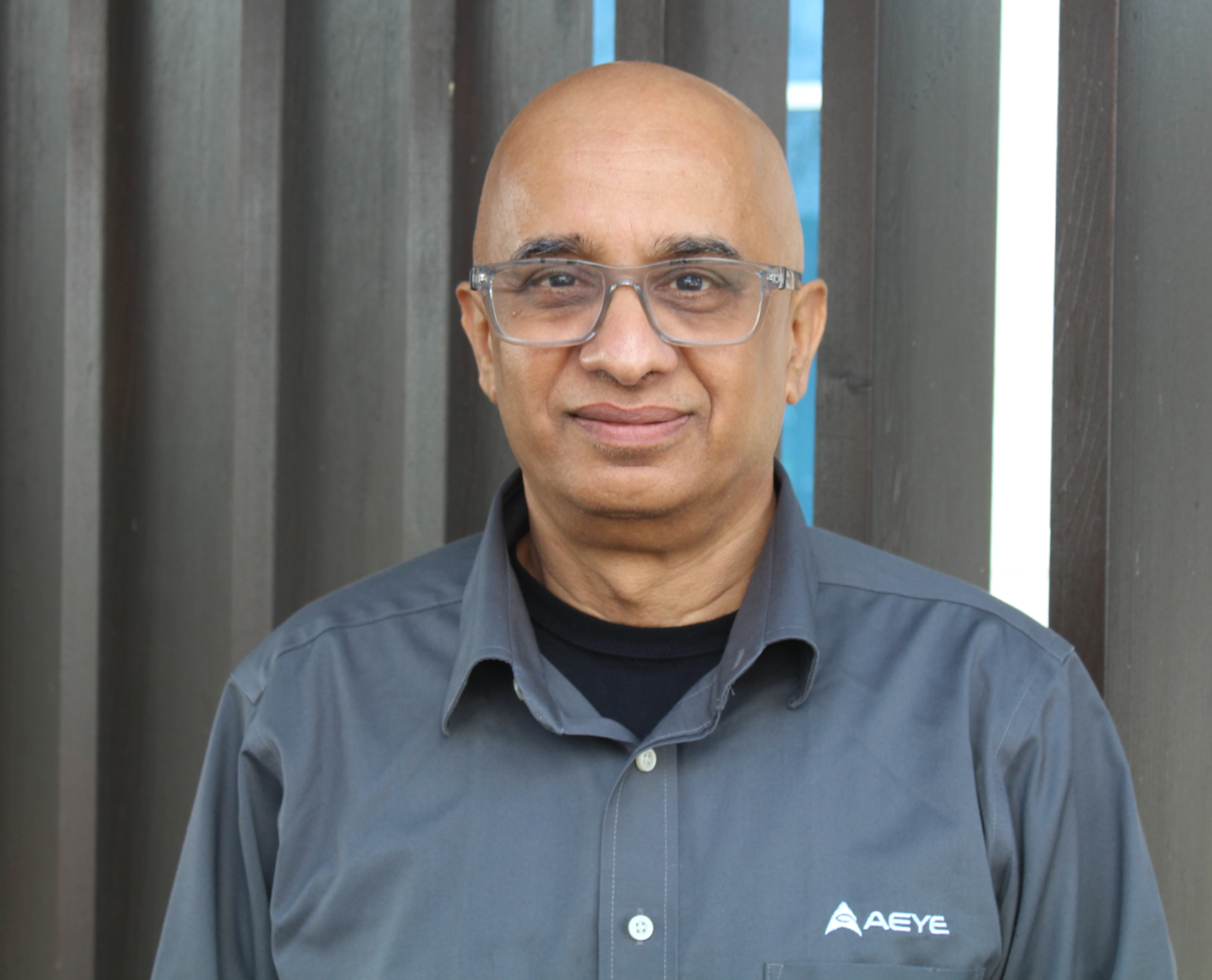
This week, we sat down with AEye’s VP of Product Management, Balaji Ekambaram.
Balaji, who leads AEye’s product and program management functions, discusses how AEye determines its product roadmap, what differentiates the company’s lidar, and why growing up in India influenced his thoughts about transportation.
“At AEye, we firmly believe that high performance does not have to come at the cost of vehicle design; they both matter equally. When evaluating a lidar, OEMs consider different placement options that meet their performance and styling goals, and AEye’s 4Sight Flex platform is flexible to meet these needs.”
 Tell me about your role at AEye and your background
I lead the product and program management team at AEye. In this role, my team focuses on understanding and assessing the lidar market, creating product roadmaps, publishing specs, driving technical requirements, and development plans collaboratively with AEye engineering and operations teams. Our goal is to ensure that the product fits the market needs, is competitive, and can be deployed keeping in mind time-to-market.
I have been in the lidar industry since 2018. My background before lidar was primarily in the semiconductor industry, with some years in the software space. Working with various OEM and T1 customers, I have developed a deeper understanding of lidar technology, use cases, and perception requirements – all of which have helped inform how AEye builds a market-ready lidar that meets OEM demands.
What factors go into determining the product roadmap?
First and most importantly, it’s critical to understand customer applications and what problems OEMs are trying to solve. For example, the requirements could vary between highway pilot applications, where detecting small, low reflective objects such as tire fragments is very important, versus urban driving scenarios, where detection of pedestrians in the vicinity of the vehicle could drive different performance requirements. Lidar offers many advantages compared to other sensing modalities, but it’s essential to look at it in the context of the application that the customer is targeting.
Second, we consider customer requirements as defined today and how they may evolve. We know the automotive industry is going through major shifts, such as transitioning to Battery Electric Vehicles (BEV) and deploying autonomous driving technology. Lidar requirements can change based on key factors and our end-customer solution, roadmaps. Additionally, the lidar market and competition is evolving rapidly. We consider these factors and strive to balance desired product performance, cost, and schedule.
Finally, we look for the optimal technology solution built on AEye’s core platform that meets performance requirements and time-to-market goals at a low cost.
Right now, the team is focused on 4Sight Flex. How did you decide on that design?
At AEye, we firmly believe that high performance does not have to come at the cost of vehicle design; they both matter equally. When evaluating a lidar, OEMs consider different placement options that meet their performance and styling goals, and AEye’s 4Sight Flex platform is flexible to meet these needs.
As a result, reducing the form factor by ~50% compared to our current generation product was a key goal for the design team. Additionally, a roof-mounted lidar, for example, will drive a different set of KPIs than an in-cabin lidar, and our software-defined architecture is ideal for evaluating various performance tradeoffs and developing an optimal solution. So, we start with baseline performance and then tailor performance for different applications.
One of our key goals was to incorporate learnings from prior product iterations and leverage the maturity of existing IP and components. This offers our customers value by shrinking timelines and lowering the overall risk to the program. It also offers new Tier 1 partners high value in terms of lowered technical risk and lower investment cost in design and manufacturing.
From your POV, what does AEye’s product do that others on the market do not?
Several things. First, our ultra-long-range detection. We believe we have the best 1550 nm lidar implementation in the market, which offers long-range performance of 300 meters or more for low reflective targets. This is without compromising on the resolution and the detection of small objects, and it applies to passenger vehicles and trucking applications.
Second, we were the first in the industry with a software-defined lidar and a software-defined architecture. We leverage this to generate tailored scan patterns for customer-specific application use cases without hardware changes. We have significant advantages in offering our customers a unique value proposition when selecting a lidar.
The third, I would say, is our next-generation product, 4Sight Flex, which comes in a small form factor that enables various mounting placements such as in-cabin, on the roof, and in the grille.
Finally, our automotive-ready product has matured through a deep three-year partnership with a leading automotive Tier 1. Aside from the reuse of components and hardware, many of our next-generation product software, firmware capabilities, and algorithms have significant reuse from prior-generation products, enabling us to deliver a higher level of maturity from the start.
From a business perspective, AEye’s flexible licensing model allows Tier 1 to minimize their upfront investment and take ownership of industrialization, customer interface, and service. AEye is driving innovative designs, developing core lidar hardware and software, engineering know-how, and providing support. That’s a very attractive, low-risk business model for OEMs where each party plays to each other’s strength to accelerate time to value.
What’s your favorite mode of transportation?
My favorite mode of transportation would have to be trains. I grew up in India, where trains are an integral part of daily life and a fascination growing up as a young Indian kid. If you look at what’s happening in India right now, there is a strong emphasis on high-speed trains. One day, I envision lidar applications also becoming mainstream in trains of all types to promote safety.