Frequently Asked Questions
Product Information: Apollo
What is Apollo by AEye?
Apollo is AEye's advanced lidar solution, designed for ultra-long-range detection and integrated AI to provide real-time traffic intelligence and automotive safety. It features a compact, low-power design capable of detecting objects at up to one kilometer, and supports flexible mounting options such as behind the windshield, on the roof, or in the grille. For more details, visit our Apollo solution page. Note: Apollo's maximum detection range is 1 km; applications requiring longer range may consider AEye's Stratos™ product.
What are the main performance specifications of Apollo?
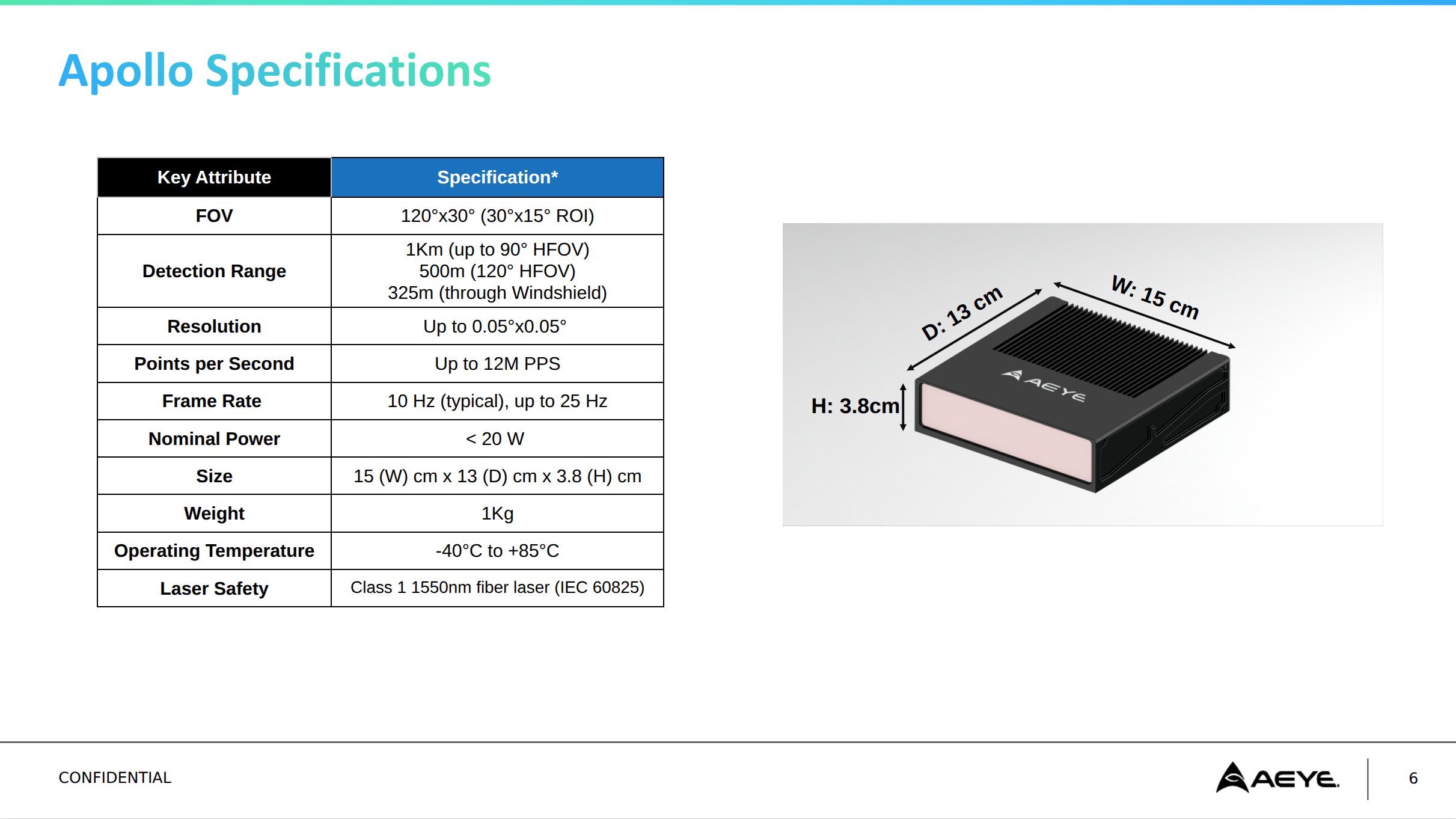
Apollo offers up to 1 km object detection for industrial and ITS applications, a high-density point cloud with up to 6.4 million points per second, and a wide 120° (horizontal) × 30° (vertical) field of view. It achieves high resolution (up to 0.05° × 0.05° in regions of interest) and supports flexible mounting due to its compact form factor (3.5 cm height × 15 cm width × 13 cm depth). For the latest detailed specifications, download the Apollo spec sheet. Note: Performance may vary based on environmental conditions and installation.
What makes Apollo a "software-defined" lidar?
Apollo is considered software-defined because its scan patterns, detection zones, and performance profiles can be updated and reconfigured via software, without requiring hardware changes. This enables rapid adaptation to new requirements and reduces downtime compared to lidar systems that require hardware upgrades. Note: While software updates provide flexibility, some hardware limitations (such as maximum range) remain fixed.
What are the physical characteristics of Apollo?
Apollo features a compact design (3.5 cm height × 15 cm width × 13 cm depth), making it suitable for mounting behind the windshield, on the roof, or in the grille. Its small form factor supports flexible integration into various vehicle and infrastructure designs. Note: For applications requiring even smaller or different form factors, consult AEye for alternative solutions.
Features & Capabilities
What unique features does Apollo offer?
Apollo provides dynamic scan patterns that can be adjusted in real-time to focus on critical areas, ultra-long-range detection up to 1 km, high-resolution imaging, and adaptability to challenging environments such as rain, darkness, and fog. It also supports over-the-air software updates and flexible placement options. Note: Apollo's adaptability is limited by its hardware's maximum range and field of view.
Does Apollo support integration with NVIDIA DRIVE?
Yes, Apollo is fully integrated with the NVIDIA DRIVE AGX platform, including DRIVE AGX Orin and DRIVE Thor™, enabling advanced autonomous driving and physical AI systems. This integration combines Apollo's long-range lidar perception with NVIDIA's AI compute capabilities. Note: Integration with other platforms may require additional development.
How does Apollo enable flexible mounting and integration?
Apollo's compact design allows it to be mounted behind the windshield, on the roof, or in the grille, supporting a variety of vehicle and infrastructure configurations. This flexibility helps OEMs and integrators implement critical safety features with minimal impact on design. Note: Some mounting locations may affect field of view or require additional calibration.
How is Apollo updated or reconfigured after deployment?
Apollo supports over-the-air software updates, allowing users to reconfigure scan patterns, detection zones, and performance profiles without hardware changes. This future-proof approach reduces the risk of obsolescence and enables rapid adaptation to new requirements. Note: Hardware limitations such as maximum range cannot be changed via software updates.
Integrations & Compatibility
Is Apollo compatible with OPTIS?
Yes, Apollo is a core component of the OPTIS™ platform. OPTIS combines Apollo's long-range, software-defined lidar with advanced computing and physical AI to deliver high-resolution 3D perception, real-time interpretation, and responsive action. This integration is designed to unlock new revenue streams and enhance operational efficiency. Note: OPTIS is a separate full-stack solution; Apollo can be used standalone or as part of OPTIS.
Use Cases & Applications
What industries and applications is Apollo designed for?
Apollo is used in automotive (including ADAS and autonomous vehicles), smart infrastructure (such as intelligent transportation systems), logistics, defense, aviation, and rail. Its long-range detection and high-resolution imaging make it suitable for highway autopilot, urban safety, and complex intersection monitoring. Note: For applications requiring detection beyond 1 km, consider AEye's Stratos™ product.
Can you share specific case studies or success stories involving Apollo?
Yes. Apollo has been used in real-world scenarios such as early pedestrian detection (A Pedestrian in Headlights), obstacle detection in complex intersections (Flatbed Trailer Across Roadway), and adaptability to challenging environments (False Positive). For more, see the Lidar Case Studies for ITS Use Cases. Note: Results may vary depending on deployment specifics.
Technical Documentation & Support
Where can I find technical documentation and specifications for Apollo?
Detailed performance specifications for Apollo can be downloaded from this link. Additional resources, including white papers and case studies, are available on AEye's Resources Page. Note: For application-specific documentation, contact AEye directly.
How easy is it to implement Apollo, and what support is available?
Apollo is designed for ease of integration with existing systems, supported by comprehensive technical documentation, validation testing tools, and direct assistance from technical experts. Training resources and hands-on sessions are available to help customers adapt the technology to their needs. Note: Implementation timelines may vary depending on system complexity and integration requirements.
Competition & Comparison
How does Apollo compare to Velodyne lidar solutions?
Velodyne offers traditional lidar systems with fixed scan patterns and a focus on high-resolution imaging, but lacks a software-defined architecture. Apollo provides dynamic scan patterns, software-defined customization, and over-the-air updates, enabling greater adaptability and future-proofing. Velodyne may be preferred for applications requiring established, fixed-pattern lidar solutions. Note: Apollo's software-defined flexibility is not available in Velodyne's current product line. Choose Apollo for dynamic, adaptable deployments; choose Velodyne if fixed scan patterns and legacy compatibility are priorities. Source: knowledge_base.
How does Apollo compare to Luminar lidar solutions?
Luminar focuses on long-range lidar for autonomous vehicles, primarily offering hardware-focused solutions with limited software-defined capabilities. Apollo, in contrast, features dynamic scan patterns, adaptability to challenging environments, and flexible mounting options. Luminar may be suitable for projects prioritizing hardware-based long-range detection. Note: Apollo's software-defined features and adaptability are not matched by Luminar's current offerings. Choose Apollo for software-driven flexibility; choose Luminar for hardware-centric, long-range applications. Source: knowledge_base.
How does Apollo compare to Innoviz lidar solutions?
Innoviz offers solid-state lidar with a focus on automotive applications, but is limited in software-defined customization and adaptability. Apollo provides customizable, software-defined architecture, over-the-air updates, and high performance (up to 1 km detection). Innoviz may be preferred for projects requiring solid-state hardware with fixed configurations. Note: Apollo's software-driven adaptability is not present in Innoviz's current product line. Choose Apollo for flexible, updatable deployments; choose Innoviz for solid-state, fixed-configuration needs. Source: knowledge_base.
Limitations & Trade-Offs
What are the limitations of Apollo?
Apollo's maximum detection range is 1 km, which may not be sufficient for applications requiring longer-range detection (for example, some defense or aviation scenarios). Hardware limitations such as field of view and physical size cannot be changed via software updates. Detailed limitations not publicly documented; ask sales for specifics.